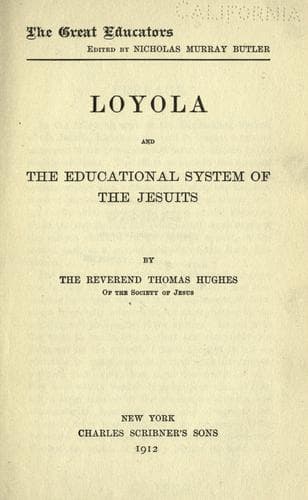
Loyola and the Educational System of the JesuitsHughes, Thomas
History
Loyola and the Educational System of the Jesuits
Hughes, Thomas
Education -- History; Ignatius, of Loyola, Saint, 1491-1556; Jesuits
The grades of the gymnasium may include several divisions, according
to the number of students; but the grading itself remains fixed, and
leaves no element, either of actual culture, or of future developments,
unprovided for, or without a location. Nor do these grades mean five
years. They mean a work to be done in each grade, before the next
is taken up. On this, the mind of Ignatius was most explicit. As an
almost universal rule, they never mean less than five years. And, for
one of them, the grade of Rhetoric, in which all literary perfection
is to be acquired, the system contemplates two and even three years.
In this point, too, we may note a characteristic view of Ignatius.
It is that the longer term, whenever provided, whenever prescribed,
urged, and insisted upon, is always for the talented student, the one
who is to become eminent. To use his own words, when laying down the
rules in this matter for the Rector of a University, his full idea
will be carried out, when "those who are of the proper age, and have
the aptitude of genius, endeavor to succeed in every branch and to be
_conspicuous therein_."[79]
To enumerate now some of the subordinate elements in the Jesuit method,
I will quote from the same author, Ribadeneira. He says, speaking of
young scholars: "Many means are devised, and exercises employed, to
stimulate the minds of the young--assiduous disputation, various trials
of genius, prizes offered for excellence in talent and industry. These
prerogatives and testimonies of virtue vehemently arouse the minds of
students, awake them even when sleeping, and, when they are aroused and
are running on with a good will, impel them and spur them on faster.
For, as penalty and disgrace bridle the will and check it from pursuing
evil, so honor and praise quicken the sense wonderfully, to attain the
dignity and glory of virtue." He quotes Cicero and Quintilian to the
same effect.[80]
Public-domain text, read in full here on John Shaqi.
Reviews
Reviews
No reviews yet
Be the first to share your thoughts on this work.
Join the Discussion
Join the discussion
Sign in to leave a comment or review.
Sign InorCreate an account