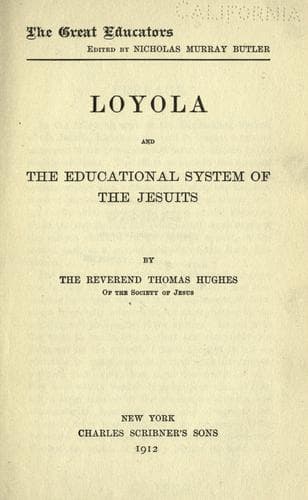
Loyola and the Educational System of the JesuitsHughes, Thomas
History
Loyola and the Educational System of the Jesuits
Hughes, Thomas
Education -- History; Ignatius, of Loyola, Saint, 1491-1556; Jesuits
Plato had put it down that "he who hath a good soul is good"; and he
insisted that no youth, who has had a personal acquaintance with evil,
can have a good soul. He did not mean that a youth must be ignorant
of what temptation is. There is no hot-house raising in this world
which will keep off that blast. Every child, while keeping on the
royal road of innocence, has enough in himself, and in the choicest
of surroundings, to know the realities of life and its warfare. But
Plato refers to a personal experience of the by-ways, which are not
virtue, and which it is not necessary to travel by, in order to know
enough about them. The educational means, the industry, the vigilance,
which have for a result the preservation of youth in the freshness of
innocence, signify a medium of respiration which is kept pure, and a
moral nutriment which is good and is kept constantly supplied, until
tender virtue has risen steadily into a well-knit rectitude, and is
able thenceforth to brave manfully the incidental storms of life.
For this moral strengthening of character, no less than for the
invigorating of mental energies, the system of Ignatius Loyola
prescribes an education which is public,--public, as being that of many
students together, public as opposed to private tutorism, public, in
fine, as requiring a sufficiency of the open, fearless exercise both
of practical morality and of religion. Since the time of Ignatius,
Dupanloup has observed on this subject:--
"I have heard a man of great sense utter this remarkable word. 'If
a usurping and able government wanted to get rid of great races in
the country, and root them out, it need only come down to this, that
it require of them, out of respect for themselves, to bring up their
children at home, alone, far from their equals, shut up in the narrow
horizon of a private education and a private tutor.'"[97]
The youthful material, on which the Jesuit system had to work, may be
described from two points of view. There were home conditions; and
there were conditions too of the educational system, which was commonly
prevalent in those centuries.
As to the circumstances of polite society at the boys' homes, Charles
Lenormant, speaking of those times, tells us that "it was the privilege
of a gentleman to have from his infancy the responsibility of his own
actions. The fathers of families were the first to launch their sons
into the midst of the perils of the world, even before the age of
discernment had begun."[98] Even when boys' homes effect no positive
harm, still, only too often, they answer this description, that they
undo the best of what the school training is endeavoring to effect, by
the discipline of subordination and the practice of obedience.
Public-domain text, read in full here on John Shaqi.
Reviews
Reviews
No reviews yet
Be the first to share your thoughts on this work.
Elsewhere in the archive
Join the Discussion
Join the discussion
Sign in to leave a comment or review.
Sign InorCreate an account