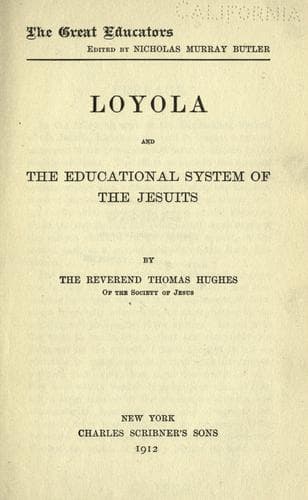
Loyola and the Educational System of the JesuitsHughes, Thomas
History
Loyola and the Educational System of the Jesuits
Hughes, Thomas
Education -- History; Ignatius, of Loyola, Saint, 1491-1556; Jesuits
"But already," he continues, "for thirty years, a great literary
event had been accomplished in secondary education. A decree of the
Parliament of Paris, dated the 16th of August, 1762, had pronounced
the expulsion of the 'ci-devant soi-disants Jésuites'; which decree
was this time definitively executed. Now the Jesuits, in their five
Provinces of France, possessed then nearly a hundred colleges. Judge
of the immense void which was suddenly created in the secondary
instruction of the Province, ill prepared for so abrupt a departure!
There was a general confusion, and a concert, as it were, of complaints
and recriminations. Where get the new masters?... The disciplinary and
financial administration of the colleges, left vacant by the Jesuits,
was confided to the bureaus, that is to say, assemblies composed of
the Archbishop or Bishop, the Lieutenant General, the King's Proctor,
and the senior Alderman.... Every one soon felt the inconveniences
of this system. The municipal officers of the cities, the bureaus
themselves hastened to petition the King, that their colleges might be
confided to religious communities. Thus it was that the greater part
of the old Jesuit colleges fell into the hands of the Benedictines and
Bernardines, of the Carmelites and Minims, of Jacobins and Cordeliers,
of Capuchins and Recollects, of Doctrinaires and Barnabites, and above
all, of the Oratorians. But all these Religious, except the Oratorians,
fell far short of the Jesuits. The greater part had not even any idea
of teaching, etc." Then the author devotes a heavy page to the novel
systems which were introduced. He closes the paragraph sadly: "All this
agitation," he says, "was unfortunately sterile; and, as I have just
said, secondary instruction, on the eve of the French Revolution, had
not taken a step forward during fifty years."
CHAPTER VII.
THE MORAL SCOPE PROPOSED.
Sweet is the holiness of youth, says Chaucer. Nor less grateful to the
eye are those gentle manners of youth, which another bard portrays as
impersonated in his "celestial lights," who say:--
We all
Are ready at thy pleasure, well disposed
To do thee gentle service.[96]
Christian morals and Christian manners make the perfect gentleman.
Public-domain text, read in full here on John Shaqi.
Reviews
Reviews
No reviews yet
Be the first to share your thoughts on this work.
Elsewhere in the archive
Join the Discussion
Join the discussion
Sign in to leave a comment or review.
Sign InorCreate an account