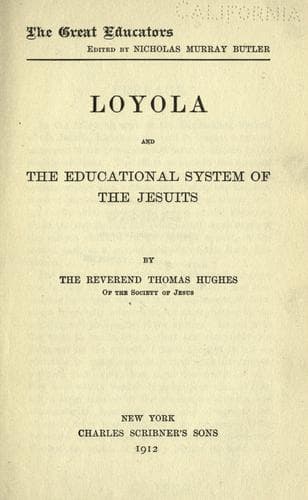
Loyola and the Educational System of the JesuitsHughes, Thomas
History
Loyola and the Educational System of the Jesuits
Hughes, Thomas
Education -- History; Ignatius, of Loyola, Saint, 1491-1556; Jesuits
The means organized by Ignatius into a method of moral education I
will sketch in the words of his contemporaries. Ribadeneira, his
biographer, says: "Those means are employed by our Masters, whereby
virtue is conceived in the hearts of the pupils, is preserved and
augmented. They are morning prayer, for obtaining grace from God not
to fall into sin; night prayer and a diligent reflection on all the
thoughts, words, and actions of the day, to do away by contrition of
heart with all the faults committed; the attentive and devout hearing
of Mass every day; frequent and humble confession of sins to a Priest;
and if they are old enough, and great devotion recommends it, and their
confessor approves of it, the reverent and pious reception of the Body
of our Lord Jesus Christ; teaching and explaining the rudiments of
the Christian faith, whereby the boys are animated to live well and
happily. Besides, great pains are taken to know and root out the vices
of boyhood, especially such as are somehow inborn and native to that
age."[103]
Here, by the way, the reader may advert to the fact that the
confessional, of which mention is made, never comes in as part of
the external means of moral development; nor is a superior ever the
confessor of those under his charge, except when desired to be so
by the free choice of the subordinate himself. A general law of the
Catholic Church ordains it thus.
Loyola's biographer goes on to the various means, whereby, in such
a multitude of young persons, the bad element, which unfortunately
will never die, is either suppressed and kept at its lowest stage of
a struggling vitality, or else, if it happens to shoot up, is weeded
out. The garden will be none the poorer for that.
Nil dabit inde minus!
There are, moreover, the division of students into categories and
ranks, with their own officers from among the boys themselves; the
degrees of honor and preëminence assigned to good conduct and virtue;
especially the pious societies or Sodalities, into which none are
admitted save the most studious and virtuous among the youths; and that
with a discrimination in favor of superior merit, even among such as
answer the general description. The Sodalities of the Society of Jesus,
as the subject of a study upon the management of youth, and indeed upon
the cultivation of all ranks in Christian society, from Peer and Field
Marshal and Viceroy, down to the little boy beginning his career at
school, would deserve a special discourse for themselves.
Public-domain text, read in full here on John Shaqi.
Reviews
Reviews
No reviews yet
Be the first to share your thoughts on this work.
Elsewhere in the archive
Join the Discussion
Join the discussion
Sign in to leave a comment or review.
Sign InorCreate an account