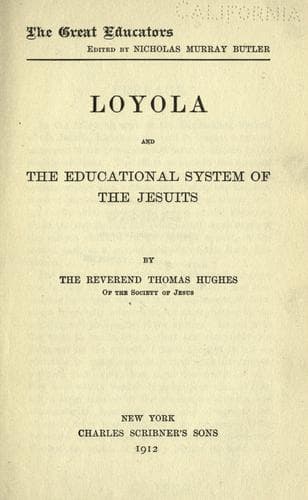
Loyola and the Educational System of the JesuitsHughes, Thomas
History
Loyola and the Educational System of the Jesuits
Hughes, Thomas
Education -- History; Ignatius, of Loyola, Saint, 1491-1556; Jesuits
What the Jesuit professors, in fact, were like, those who in after
years showed themselves but little friendly to the Order did not
omit to testify. "During the seven years," says Voltaire, "that I
lived in the house of the Jesuits, what did I see among them? The
most laborious, frugal, and regular life, all their hours divided
between the care they spent on us and the exercises of their austere
profession. I attest the same as thousands of others brought up by
them, like myself; not one will be found to contradict me. Hence I
never cease wondering how any one can accuse them of teaching corrupt
morality.... Let any one place side by side the 'Provincial Letters'
and the Sermons of Father Bourdaloue; he will learn in the former
the art of raillery, the art of presenting things, indifferent in
themselves, under aspects which make them appear criminal, the art of
insulting with eloquence; he will learn from Father Bourdaloue, that of
being severe to oneself, and indulgent toward others."[109]
History is uniform in bearing witness that the general effects of their
teaching corresponded to the example of these Professors, in spite
of the fact, as Cretineau-Joly puts it, that even from the hands of
religious men the impious can still come forth, as, in the school of
the wise, dunces and dolts may still be found.[110] Man is still and
always free. However, if it follows thence, that not only a positive,
but a negative result may always be expected; such a double result may
be set off by two consoling reflections, which I will mention, in order
to complete the picture of this education in practice.
The first is, that since, from the school of virtue and religiousness,
vice can still issue forth, and, as the General Vitelleschi says, a
good education, though almost omnipotent, may, like the morning dew,
evaporate and be lost in the first heat of manhood's passions,[111]
what would be the results of the system, if it had less piety to
enlighten, or less of an organized practice of virtue to confirm, the
minds and hearts of the young?
Another reflection is this: that human nature, however erratic by
defect of will, still remains beautiful, thanks to the original
gift of God. Whence it comes, that impiety is found beautifully
inconsistent; and, in its lucid intervals, it makes the due
acknowledgment, as he did, who once said:--
O thou, that with surpassing glory crowned,
Look'st from thy sole dominion ...
To thee I call....
To tell thee how I hate thy beams,
That bring to my remembrance from what state
I fell.[112]
The Society of Jesus has many a time been elegantly blessed and cursed
by the same eloquent lips and pens.
Public-domain text, read in full here on John Shaqi.
Reviews
Reviews
No reviews yet
Be the first to share your thoughts on this work.
Elsewhere in the archive
Join the Discussion
Join the discussion
Sign in to leave a comment or review.
Sign InorCreate an account