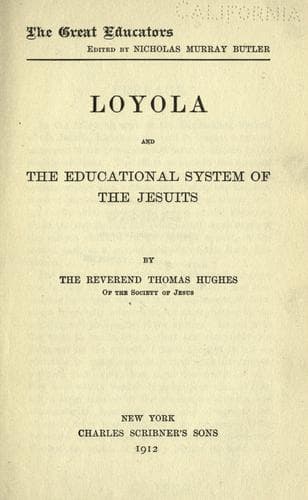
Loyola and the Educational System of the JesuitsHughes, Thomas
History
Loyola and the Educational System of the Jesuits
Hughes, Thomas
Education -- History; Ignatius, of Loyola, Saint, 1491-1556; Jesuits
They concern us from a pedagogic point of view, in many ways. They
wrote text-books, many of which are the basis of manuals in almost
every line of education to-day, sometimes without the change of a
word, and generally without acknowledgment. Besides that, their
literary productions were, as a rule, the offspring of their labors
in the schools. It might not be safe to estimate their standing as
_littérateurs_, by the process which a Scotch Professor uses, who,
in the course of forty-seven elegant lectures on Rhetoric and Belles
Lettres, sees little occasion to recognize the existence of this Jesuit
school of literature, except when he goes out of his way to salute Père
Rapin in a somewhat questionable manner.[137] Many of those whom the
Scottish Professor himself does honor to, in his pages, were Jesuit
scholars,--Bossuet, Corneille, Molière, Tasso, Fontenelle, Didérot,
Voltaire, Bourdaloue, himself a Jesuit. It would be safer then to
determine the standing of these Professors, who were in control of a
great literary age, by looking at the golden age itself, that of Louis
XIV. The majority of the brilliant figures, whom Dr. Blair names as
illustrating the epoch,[138] were all Jesuit scholars. Naturally, then,
the fifty Professors of the Jesuit College at Paris were, as Cardinal
Maury affirmed, a permanent tribunal of literature for all men of
letters, a high court of judicature, a focus of public attention from
which radiated the public opinion of the capital; in short, as Piron
had emphatically said, "the Star-chamber of literary reputations."[139]
Devoted as they were to an austere profession, we may say of many among
them, that they were not themselves romancers of a lively fancy or
great poets; and so far agree with Voltaire, who made this very remark
about his old Professor, Père Porée. Yet also, without inconsistency
I believe, we may agree with the spirit of Père Porée's rejoiner, when
the remark was reported to him, that "he was not one of the great
poets." The Jesuit replied, "At least you may grant that I have been
able to make some of them."
And, should results be gauged on a wider basis than mere poetry, not
a few of the most prominent men in European history would seem to
have been the outcome of this system, men, too, who represented every
possible school and tendency, in their subsequent literary and public
life. A few names show this. There are those of Descartes, Buffon,
Justus Lipsius, Muratori, Calderon, Vico, the jurisconsult, founder
of the philosophical school of history. There are Richelieu, Tilly,
Malesherbes, Don John of Austria, Luxembourg, Esterhazy, Choiseul,
with those of Saint Francis de Sales, founder of a religious Order,
Lambertini, afterwards the most learned of Popes, under the name of
Benedict XIV, and the present Pontiff, Leo XIII, also most erudite.
These certainly represent many schools and tendencies, and they come,
with many others, from the same schools.[140]
Public-domain text, read in full here on John Shaqi.
Reviews
Reviews
No reviews yet
Be the first to share your thoughts on this work.
Elsewhere in the archive
Join the Discussion
Join the discussion
Sign in to leave a comment or review.
Sign InorCreate an account