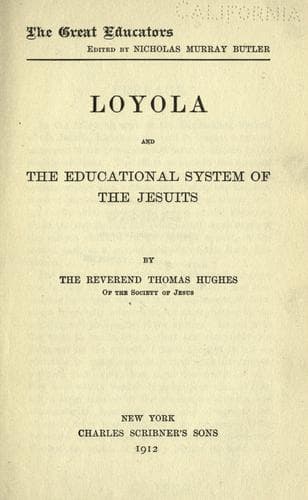
Loyola and the Educational System of the JesuitsHughes, Thomas
History
Loyola and the Educational System of the Jesuits
Hughes, Thomas
Education -- History; Ignatius, of Loyola, Saint, 1491-1556; Jesuits
Those years of novitiate are blank, under the aspect of secular
pursuits. But, in other respects, being a time for reflection and for
internal application to the affairs of his mind and heart, they are
worth a long season in the process of developing character, by habits
of assiduous labor, of acquiring a taste for retirement and virtue, and
practising the spirit of docility to counsel. Indeed, on issuing from
this period of intense application to the knowledge of self, the young
religious student is already started on his career of knowing men, and
dealing successfully with human characters. Henceforth, ecclesiastical
knowledge and other acquirements will be proper to his state, as a
Religious; but, for the special vocation of the Society of Jesus, he
returns to secular studies.
In view of his approaching "regency," or Professorship in the
curriculum of letters, the critics of 1586 give this advice: "It
would be most profitable for the schools, if those who are about
to be Preceptors were privately taken in hand by some one of great
experience; and, for two months or more, were practised by him in
the method of reading, teaching, correcting, writing, and managing a
class. If teachers have not learnt these things beforehand, they are
forced to learn them afterwards at the expense of their scholars; and
then they will acquire proficiency only when they have already lost
in reputation; and perchance they will never unlearn a bad habit.
Sometimes, such a habit is neither very serious nor incorrigible, if
taken at the beginning; but, if the habit is not corrected then, it
comes to pass that a man, who otherwise would have been most useful,
becomes well-nigh useless. There is no describing how much amiss
Preceptors take it, if they are corrected, when they have already
adopted a fixed method of teaching; and what continual disagreement
ensues on that score with the Prefects of Studies. To obviate this
evil, in the case of our Professors, let the Prefect in the chief
College, whence our Professors of Humanities and Grammar are usually
taken, remind the Rector and Provincial, about three months before the
next scholastic year begins, that, if the Province needs new Professors
for the following term, they should select some one eminently versed
in the art of managing classes, whether he be, at the time, actually
a Professor, or a student of Theology or Philosophy; and to him the
future Masters are to go daily for an hour, to be prepared by him for
their new ministry, giving prelections in turn, writing, dictating,
correcting, and discharging the other duties of a good teacher."[161]
Public-domain text, read in full here on John Shaqi.
Reviews
Reviews
No reviews yet
Be the first to share your thoughts on this work.
Elsewhere in the archive
Join the Discussion
Join the discussion
Sign in to leave a comment or review.
Sign InorCreate an account