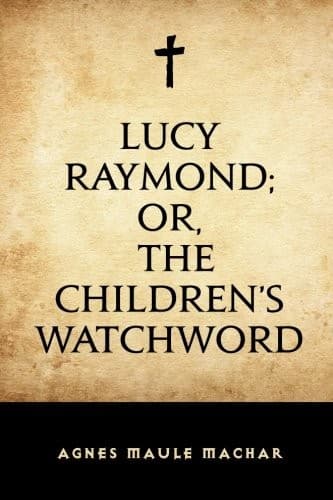
Lucy Raymond; Or, The Children's WatchwordMachar, Agnes Maule
Religion
Lucy Raymond; Or, The Children's Watchword
Machar, Agnes Maule
Children -- Religious life
The sadness of her departure soon wore off amid the pleasant
excitement of the long and interesting journey, made doubly pleasant
by the lively and genial companionship of her new friends, who won her
heart at once by their warm praises of Alick and Harry; and she began
already to look forward to the happiness of their complete reunion as
a family,--for Fred was to follow her to the West at the close of his
theological studies, in the ensuing spring.
When at last the somewhat fatiguing but very pleasant journey was at
an end, Lucy found Mrs. Steele ready to receive her with a warm
maternal welcome, and Harry wild with delight, as much grown and
improved as they all declared she was. Alick had grown considerably
older and graver-looking under the responsibilities of life and his
profession, though he still retained much of his old flow of spirits;
and Lucy had the very great pleasure of finding that he had become an
earnest Christian man, using his profession to the utmost of his power
as a means not only of doing temporal good, but of advancing his
Master's cause.
Lucy soon saw that her household aid was so much needed by her aunt,
whose health had become very feeble, that she relinquished the plan
she had formed of endeavouring to get employment in teaching during
the winter; and between her housekeeping avocations and the claims of
Alick's poor patients, whom she often visited on errands of charity,
and the carrying on of her own studies, which she was anxious to
continue, the winter flew past with incredible rapidity.
When the season of budding leaves and opening blossoms returned, there
came tidings--sad indeed, yet by no means unexpected--from the sandy
plains of Florida. Stella was dead, but she had died "looking unto
Jesus," and in the feeling of her perfect safety and happiness with
her Saviour. Lucy could acquiesce in the earthly separation from her.
She had seemed to be one over whom "things seen and temporal" held so
much power, that perhaps only the pressure of physical disease, and
the realization of the possible approach of death, could have brought
her to the invisible but ever-present Saviour. Her temporal loss had
thus been her great gain; yet still "more blessed are they" who
without such pressure "have believed."
Public-domain text, read in full here on John Shaqi.
Reviews
Reviews
No reviews yet
Be the first to share your thoughts on this work.
Elsewhere in the archive
Join the Discussion
Join the discussion
Sign in to leave a comment or review.
Sign InorCreate an account