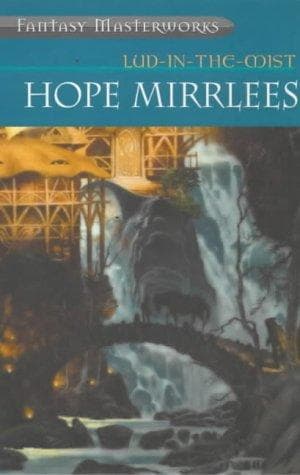
Fairies -- Fiction; Fantasy fiction; Imaginary places -- Fiction
The first night they camped out in a field, and when they had lighted
a fire Diggory opened the sack that, with the farmer's permission, he
had taken from the granary, in order that his wife might make them some
lentil soup for supper. But lo and behold! instead of lentils the sack
contained fruit--fruit that Diggory Carp, as a west countryman, born
and bred near the Elfin Marches, recognised at the first glance to be
of a kind that he would not dream of touching himself or of allowing
his wife and children to touch ... the sack, in fact, contained fairy
fruit. So they buried it in the field, for, as Diggory said, "Though
the stuff be poison for men, they do say as how it's a mighty fine
manure for the crops."
For a week or so they tramped the country, living from hand to mouth.
Sometimes Diggory would earn a little by doing odd jobs for the
farmers, or by playing the fiddle at village weddings, for Diggory, it
would seem, was a noted fiddler.
But with the coming of winter they began to feel the pinch of poverty,
and his wife bethought her of the trade of basket-making she had
learned in her youth; and, as they were camping at the time at the
place where grew the best osiers for the purpose, she determined to
see if her fingers had retained their old cunning. As the sap of these
particular osiers was a deadly poison, she would not allow the children
to help her to gather them.
So she set to and make wicker urns in which the farmers' wives could
keep their grain in winter, and baskets of fancy shapes for lads to
give to their sweethearts to hold their ribbands and fal-lals. The
children peddled them about the countryside, and thus they managed to
keep the pot boiling.
The following summer, shortly before harvest, Diggory's eldest girl
went to try and sell some baskets in the village of Swan. There she
met the defendant, whom she asked to look at her wares, relying on not
being recognised as a daughter of Diggory's, through having been in
service at another farm when her father was working at the Gibbertys'.
The defendant seemed pleased with the baskets, bought two or three, and
got into talk with the girl about the basket-making industry, in the
course of which she learned that the best osiers for the purpose were
very poisonous. Finally she asked the girl to bring her a bundle of the
osiers in question, as making baskets, she said, would make a pleasant
variety, of an evening, from the eternal spinning; and in the course of
a few days the girl brought her, as requested, a bundle of the osiers,
and was well paid for them.
Public-domain text, read in full here on John Shaqi.
Reviews
Reviews
No reviews yet
Be the first to share your thoughts on this work.
Elsewhere in the archive
Join the Discussion
Join the discussion
Sign in to leave a comment or review.
Sign InorCreate an account