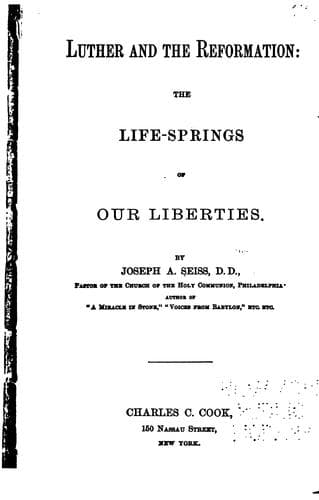
Luther and the Reformation:: The Life-Springs of Our LibertiesSeiss, Joseph Augustus
History
Luther and the Reformation:: The Life-Springs of Our Liberties
Seiss, Joseph Augustus
Luther, Martin, 1483-1546; Pennsylvania -- History -- Colonial period, ca. 1600-1775
[15] Chevalier Bunsen says; "It is Luther's genius applied to the
Bible which has preserved the only unity which is, in our days,
remaining to the German nation--that of language, literature, and
thought. There is no similar instance in the known history of the
world of a single man achieving such a work."
LUTHER'S CONSERVATISM.
Up to the time of Luther's residence in the Wartburg nothing had been
done toward changing the outward forms, ceremonies, and organization
of the Church. The great thing with him had been to get the inward,
central doctrine right, believing that all else would then naturally
come right in due time. But while he was hidden and silent certain
fanatics thrust themselves into this field, and were on the eve of
precipitating everything to destruction. Tidings of the violent
revolutionary spirit which had broken out reached him in his retreat
and stirred him with sorrowful indignation, for it was the most
damaging blow inflicted on the Reformation.
It is hard for men to keep their footing amid deep and vast commotions
and not drift into ruinous excesses. Storch, and Muenzer, and
Carlstadt, and Melanchthon himself, were dangerously affected by the
whirl of things. Even good men sometimes forget that society cannot be
conserved by mere negations; that wild and lawless revolution can
never work a wholesome and abiding reformation; that the perpetuity of
the Church is an historic chain, each new link of which depends on
those which have gone before.
There was precious gold in the old conglomerate, which needed to be
discriminated, extracted, and preserved. The divine foundations were
not to be confounded with the rubbish heaped upon them. There was
still a Church of Christ under the hierarchy, although the hierarchy
was no part of its life or essence. The Zwickau prophets, with their
new revelations and revolts against civil authority; the Wittenberg
iconoclasts, with their repudiation of study and learning and all
proper church order; and the Sacramentarians, with their insidious
rationalism against the plain Word,--were not to be entrusted with
the momentous interests with which the cause of the Reformation was
freighted. And hence, at the risk of the Elector's displeasure and at
the peril of his life, Luther came forth from his covert to withstand
the violence which was putting everything in jeopardy.
Grandly also did he reason out the genuine Gospel principles against
all these parties. He comprehended his ground from centre to
circumference, and he held it alike against erring friends and
menacing foes. The swollen torrent of events never once obscured his
prophetic insight, never disturbed the balance of his judgment, never
shook his hold upon the right. With a master-power he held revolutions
and wars in check, while he revised and purified the Liturgy and Order
of the Church, wrought out the evangelic truth in its applications to
existing things, and reared the renewed habilitation of the pure Word
and sacraments.
Public-domain text, read in full here on John Shaqi.
Reviews
Reviews
No reviews yet
Be the first to share your thoughts on this work.
Elsewhere in the archive
Join the Discussion
Join the discussion
Sign in to leave a comment or review.
Sign InorCreate an account