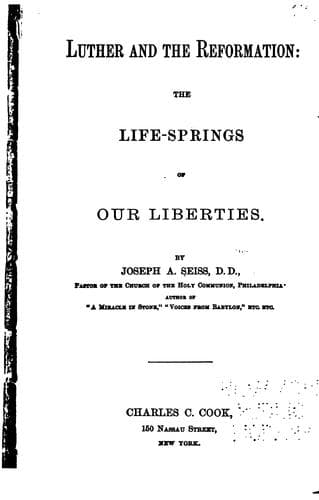
Luther and the Reformation:: The Life-Springs of Our LibertiesSeiss, Joseph Augustus
History
Luther and the Reformation:: The Life-Springs of Our Liberties
Seiss, Joseph Augustus
Luther, Martin, 1483-1546; Pennsylvania -- History -- Colonial period, ca. 1600-1775
GROWTH OF THE REFORMATION.
It was now that Pope Leo died. His glory lasted but eight years. His
successor, Adrian VI., was a moderate man, of good intentions, though
he could not see what evil there was in indulgences. He exhorted
Germany to get rid of Luther, but said the Church must be reformed,
that the Holy See had been for years horribly polluted, and that the
evils had affected head and members. He was in solemn earnest this
time, and began to change and purify the papal court. To some this was
as if the voice of Luther were being echoed from St. Peter's chair,
and Adrian suddenly died, no man knows of what,[16] and Clement VII.,
a relative of Leo X., was put upon the papal throne.
In 1524 a Diet was convened at Nuremberg with reference to these same
matters. Campeggio, the pope's legate, thought it prudent to make his
way thither without letting himself be known, and wrote back to his
master that he had to be very cautious, as the majority of the Diet
consisted of "great Lutherans." At this Diet the Edict of Worms was
virtually annulled, and it was plain enough that "great Lutherans" had
become very numerous and powerful.
Luther himself had become of sufficient consequence for Henry VIII.,
king of England, to write a book against him, for which the pope gave
him the title of "Defender of the Faith," and for which Luther repaid
him in his own coin. Erasmus also, long the prince of the whole
literary world, was dogged into the writing of a book against the
great Reformer. Poor Erasmus found his match, and was overwhelmed with
the result. He afterward sadly wrote: "My troops of friends are turned
to enemies. Everywhere scandal pursues me and calumny denies my name.
Every goose now hisses at Erasmus."
In 1525, Luther's friend and protector, the Elector Frederick, died.
This would have been a sad blow for the Reformation had there been no
one of like mind to take his place. But God had the man in readiness.
"Frederick the Wise" was succeeded by his brother, "John the
Constant."
In Hesse, in Holland, in Scandinavia, in Prussia, in Poland, in
Switzerland, in France, _everywhere_, the Reformation advanced. Duke
George of Saxony raged, got up an alliance against the growing cause,
and beheaded citizens of Leipsic for having Luther's writings in their
houses. Eck still howled from Ingolstadt for fire and fagots. The
dukes of Bavaria were fierce with persecutions. The archbishop of
Mayence punished cities because they would not have his priests for
pastors. The emperor from Spain announced his purpose to crush and
exterminate "the wickedness of Lutheranism." But it was all in vain.
The sun had risen, the new era had come!
Public-domain text, read in full here on John Shaqi.
Reviews
Reviews
No reviews yet
Be the first to share your thoughts on this work.
Elsewhere in the archive
Join the Discussion
Join the discussion
Sign in to leave a comment or review.
Sign InorCreate an account