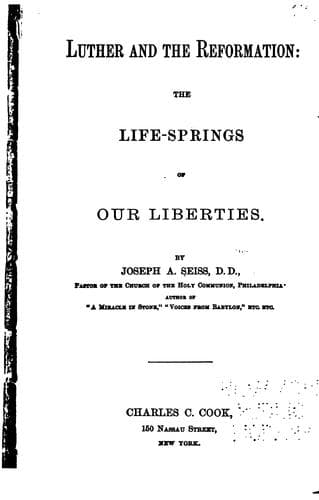
Luther and the Reformation:: The Life-Springs of Our LibertiesSeiss, Joseph Augustus
History
Luther and the Reformation:: The Life-Springs of Our Liberties
Seiss, Joseph Augustus
Luther, Martin, 1483-1546; Pennsylvania -- History -- Colonial period, ca. 1600-1775
And yet another Imperial Diet was convened with reference to these
religious disturbances. It was held in Augsburg in the spring of 1530.
The emperor was in the zenith of his power. He had overcome his French
rival. He had spoiled Rome, humbled the pope, and reorganized Italy.
The Turks had withdrawn their armies. And the only thing in the way of
a consolidated empire was the Reformation in Germany. To crush this
was now his avowed purpose, and he anticipated no great hardship in
doing it. He entered Augsburg with unwonted magnificence and pomp. He
had spoken very graciously in his invitation to the princes, but it
was in his heart to compel their submission to his former Edict of
Worms. It behoved them to be prepared to make a full exhibit of their
principles, giving the ultimatum on which they proposed to stand.
Luther had been formulating articles embodying the points adhered to
in his reformatory teachings. He had prepared one set for the Marburg
Conference with the Swiss divines. He had revised and elaborated these
into the Seventeen Articles of Schwabach. He had also prepared another
series on abuses, submitted to the Elector John at Torgau. All these
were now committed to Melanchthon for careful elaboration into
complete style and harmony for use at the Diet. Luther assisted in
this work up to the time when the Diet convened, and what remained to
be done was completed in Augsburg by Melanchthon and the Lutheran
divines present with him. Luther himself could not be there, as he was
a dead man to the law, and by command of his prince was detained at
Coburg while the Diet was in session.
The first act of the emperor was to summon the protesting princes
before him, asking of them the withdrawal of their Protest. This they
refused. They felt that they had constitutional right, founded on the
decision of Spire, to resist the emperor's demand; and they did not
intend to surrender the just principles put forth in their noble
Protest. They celebrated divine service in their quarters, led by
their own clergy, and refused to join in the procession at the Roman
festival of Corpus Christi. This gave much offence, and for the sake
of peace they discontinued their services during the Diet.
At length they were asked to make their doctrinal presentation.
Melanchthon had admirably performed the work assigned him in the
making up of the Confession, and on the 25th day of June, 1530, the
document, duly signed, was read aloud to the emperor in the hearing of
many.
Public-domain text, read in full here on John Shaqi.
Reviews
Reviews
No reviews yet
Be the first to share your thoughts on this work.
Elsewhere in the archive
Join the Discussion
Join the discussion
Sign in to leave a comment or review.
Sign InorCreate an account