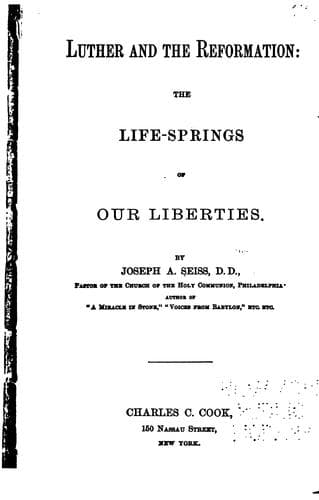
Luther and the Reformation:: The Life-Springs of Our LibertiesSeiss, Joseph Augustus
History
Luther and the Reformation:: The Life-Springs of Our Liberties
Seiss, Joseph Augustus
Luther, Martin, 1483-1546; Pennsylvania -- History -- Colonial period, ca. 1600-1775
The effect of it upon the assembly was indescribable. Many of the
prejudices and false notions against the Reformers were effectually
dissipated. The enemies of the Reformation felt that they had solemn
realities to deal with which they had never imagined. Others said that
this was a more effectual preaching than that which had been
suppressed. "Christ is in the Diet," said Justus Jonas, "and he does
not keep silence. God's Word cannot be bound." In a word, the world
now had added to it one of its greatest treasures--the renowned and
imperishable AUGSBURG CONFESSION.
Luther was eager for tidings of what transpired at the Diet. And when
the Confession came, as signed and delivered, he wrote: "I thrill with
joy that I have lived to see the hour in which Christ is preached by
so many confessors to an assembly so illustrious in a form so
beautiful."
Even Reformed authors, from Calvin down, have cheerfully added their
testimony to the worth and excellence of this magnificent
Confession--the first since the Athanasian Creed. A late writer of
this class says of it that "it best exhibits the prevailing genius of
the German Reformation, and will ever be cherished as one of the
noblest monuments of faith from the pentecostal period of
Protestantism."
The Romanists attempted to answer the noble Confession, but would not
make their Confutation public. Compromises were proposed, but they
came to naught. The Imperial troops were called into the city and the
gates closed to intimidate the princes, but it resulted in greater
alarm to the Romanists than to them. The confessors had taken their
stand, and they were not to be moved from it. The Diet ended with the
decision that they should have until the following spring to determine
whether they would submit to the Roman Church or not, and, if not,
that measures would then be taken for their extermination.
THE LEAGUE OF SMALCALD.
The emperor's edict appeared November 19th, and the Protestant princes
at once proceeded to form a league for mutual protection against
attempts to force their consciences in these sacred matters. It was
with difficulty that the consent of Luther could be obtained for what,
to him, looked like an arrangement to support the Gospel by the sword.
But he yielded to a necessity forced by the intolerance of Rome. A
convention was held at Smalcald at Christmas, 1530, and there was
formed the _League of Smalcald_, which planted the political
foundations of Religious Liberty for our modern world.
By the presentation of the great Confession of Augsburg, along with
the formation of the League of Smalcald, the cause of Luther became
embodied in the official life of nations, and the new era of Freedom
had come safely to its birth. Long and terrible storms were yet to be
passed, but the ship was launched which no thunders of emperors or
popes could ever shatter.[17]
Public-domain text, read in full here on John Shaqi.
Reviews
Reviews
No reviews yet
Be the first to share your thoughts on this work.
Elsewhere in the archive
Join the Discussion
Join the discussion
Sign in to leave a comment or review.
Sign InorCreate an account