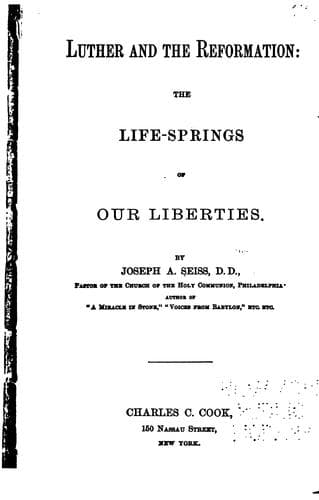
Luther and the Reformation:: The Life-Springs of Our LibertiesSeiss, Joseph Augustus
History
Luther and the Reformation:: The Life-Springs of Our Liberties
Seiss, Joseph Augustus
Luther, Martin, 1483-1546; Pennsylvania -- History -- Colonial period, ca. 1600-1775
But, though so great a genius, he laid great stress on sound and
thorough learning and study. "The strength and glory of a town," said
he, "does not depend on its wealth, its walls, its great mansions, its
powerful armaments, but in the number of its learned, serious, kind,
and well-educated citizens." He was himself a great scholar, far
beyond what we would suspect in so perturbed a life, or what he cared
to parade in his writings. He mastered the ancient languages, and
insisted on the perpetual study of them as "the scabbard which holds
the sword of the Spirit, the cases which enclose the precious jewels,
the vessels which contain the old wine, the baskets which carry the
loaves and the fishes for the feeding of the multitude." His
associates say of him that he was a great reader, eagerly perusing the
Church Fathers, old and new, and all histories, well retaining what he
read, and using the same with great skill as occasion called.
Melanchthon, who knew him well, and knew well how to judge of men's
powers and attainments, said of him: "He is too great, too wonderful,
for me to describe. Whatever he writes, whatever he utters, goes to
the soul and fixes itself like arrows in the heart. _He is a miracle
among men._"
Nor was he without the humility of true greatness. Newton's comparison
of himself to a child gathering shells and pebbles on the shore,
while the great ocean of truth lay all undiscovered before him, has
been much cited and lauded as an illustration of the modesty of true
science. But long before Newton had Luther said of himself, in the
midst of his mighty achievements, "Only a little of the first fruits
of wisdom--only a few fragments of the boundless heights, breadths,
and depths of truth--have I been able to gather."
He was a man of amazing _faith_--that mighty principle which looks at
things invisible, joins the soul to divine Omnipotence, and launches
out unfalteringly upon eternal realities, and which is ever the chief
factor in all God's heroes of every age. He dwelt in constant nearness
and communion with the Eternal Spirit, which reigns in the heavens and
raises the willing and obedient into blessed instruments of itself for
the actualizing of ends and ideals beyond and above the common course
of things. With his feet ever planted on the promises, he could lay
his hands upon the Throne, and thus was lifted into a sublimity of
energy, endurance, and command which made him one of the phenomenal
wonders of humanity. He was a very Samson in spiritual vigor, and
another Hannah's son in the strength and victory of his prayers.
Public-domain text, read in full here on John Shaqi.
Reviews
Reviews
No reviews yet
Be the first to share your thoughts on this work.
Elsewhere in the archive
Join the Discussion
Join the discussion
Sign in to leave a comment or review.
Sign InorCreate an account