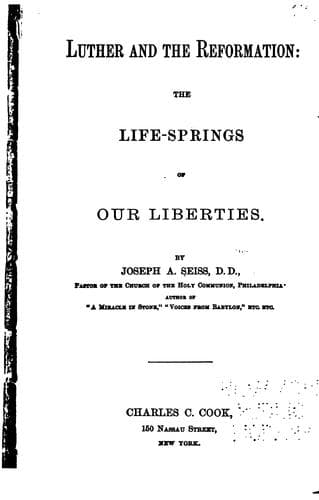
Luther and the Reformation:: The Life-Springs of Our LibertiesSeiss, Joseph Augustus
History
Luther and the Reformation:: The Life-Springs of Our Liberties
Seiss, Joseph Augustus
Luther, Martin, 1483-1546; Pennsylvania -- History -- Colonial period, ca. 1600-1775
On the German nation he has left more of his impress than any other
man has left on any nation. The German people love to speak of him as
the creative master of their noble language and literature, the great
prophet and glory of their country. There is nothing so consecrated in
all his native land as the places which connect with his life,
presence, and deeds.
But his mighty impress is not confined to Germany. "He grasped the
iron trumpet of his mother-tongue and blew a blast that shook the
nations from Rome to the Orkneys." He is not only the central figure
of Germany, but of Europe and of the whole modern world. Take Luther
away, with the fruits of his life and deeds, and man to-day would
cease to be what he is.
Frederick von Schlegel, though a Romanist, affirms that "it was upon
him and his soul that the fate of Europe depended." And on the fate
of Europe then depended the fate of our race.
Michelet, also a Romanist, pronounces Luther "the restorer of liberty
in modern times;" and adds: "If we at this day exercise in all its
plenitude the first and highest privilege of human intelligence, it is
to him we are indebted for it."
"And that any faith," says Froude, "any piety, is alive now, even in
the Roman Church itself, whose insolent hypocrisy he humbled into
shame, is due in large measure to the poor miner's son."
He certainly is to-day the most potently living man who has lived this
side of the Middle Ages. The pulsations of his great heart are felt
through the whole _corpus_ of our civilization.
"Four potentates," says the late Dr. Krauth, "ruled the mind of Europe
in the Reformation: the emperor, Erasmus, the pope, and Luther. The
pope wanes; Erasmus is little; the emperor is nothing; but Luther
abides as a power for all time. His image casts itself upon the
current of ages as the mountain mirrors itself in the river which
winds at its foot. He has monuments in marble and bronze, and medals
in silver and gold, but his noblest monument is the best love of the
best hearts, and the brightest and purest impression of his image has
been left in the souls of regenerated nations."
Many and glowing are the eulogies which have been pronounced upon him,
but Frederick von Schlegel, speaking from the side of Rome, gives it
as his conviction that "few, even of his own disciples, appreciate him
highly enough." Genius, learning, eloquence, and song have volunteered
their noble efforts to do him justice; centuries have added their
light and testimony; half the world in its enthusiasm has urged on the
inspiration; but the story in its full dimensions has not yet been
adequately told. The skill and energy of other generations will yet be
taxed to give it, if, indeed, it ever can be given apart from the
illuminations of eternity.[27]
FOOTNOTES:
Public-domain text, read in full here on John Shaqi.
Reviews
Reviews
No reviews yet
Be the first to share your thoughts on this work.
Elsewhere in the archive
Join the Discussion
Join the discussion
Sign in to leave a comment or review.
Sign InorCreate an account