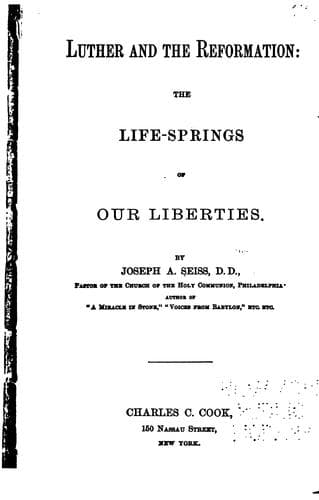
Luther and the Reformation:: The Life-Springs of Our LibertiesSeiss, Joseph Augustus
History
Luther and the Reformation:: The Life-Springs of Our Liberties
Seiss, Joseph Augustus
Luther, Martin, 1483-1546; Pennsylvania -- History -- Colonial period, ca. 1600-1775
Luther was but a man. No one claims that he was perfection. But if
those who sought his destruction while he lived had had no greater
faults than he, with better grace their modern representatives might
indulge their genius for his defamation. At best, as we might suppose,
it is the little men, the men of narrow range and narrow heart--men
dwarfed by egotism, bigotry, and self-conceit--who see the most of
these defects. Nobler minds, contemplating him from loftier
standpoints, observe but little of them, and even honor them above the
excellencies of common men. "The proofs that he was in some things
like other men," says Lessing, "are to me as precious as the most
dazzling of his virtues."[28]
And, with all, where is the gain or wisdom of blowing smoke upon a
diamond? The sun itself has holes in it too large for half a dozen
worlds like ours to fill, but wherein is that great luminary thereby
unfitted to be the matchless centre of our system, the glorious source
of day, and the sublime symbol of the Son of God?
If Luther married a beautiful woman, the proofs of which do not
appear, it is what every other honest man would do if it suited him
and he were free to do it.
If he broke his vows to get a wife, of which there is no evidence,
when vows are taken by mistake, tending to dishonor God, work
unrighteousness, and hinder virtuous example and proper life, they
ought to be broken, the sooner the better.
And, whatever else may be alleged to his discredit, and whoever may
arise to heap scandal on his name, the grand facts remain that it was
chiefly through his marvelous qualities, word, and work that the
towering dominion of the Papacy was humbled and broken for ever; that
prophets and apostles were released from their prisons once more to
preach and prophesy to men; that the Church of the early times was
restored to the bereaved world; that the human mind was set free to
read and follow God's Word for itself; that the masses of neglected
and downtrodden humanity were made into populations of live and
thinking beings; and that the nations of the earth have become
repossessed of their "inalienable rights" of "life, liberty, and the
pursuit of happiness."
"And let the pope and priests their victor scorn,
Each fault reveal, each imperfection scan,
And by their fell anatomy of hate
His life dissect with satire's keenest edge;
Yet still may Luther, with his mighty heart,
Defy their malice.
Far beyond _them_ soars the soul
They slander. From his tomb there still comes forth
A magic which appalls them by its power;
And the brave monk who made the Popedom rock
Champions a world to show his equal yet!"
FOOTNOTES:
Public-domain text, read in full here on John Shaqi.
Reviews
Reviews
No reviews yet
Be the first to share your thoughts on this work.
Elsewhere in the archive
Join the Discussion
Join the discussion
Sign in to leave a comment or review.
Sign InorCreate an account