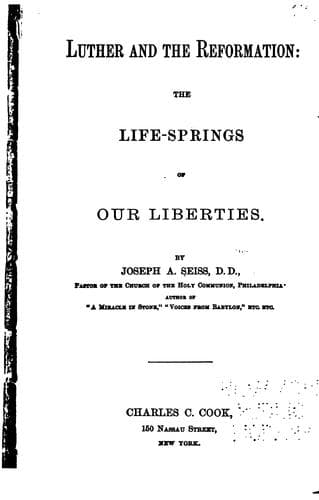
Luther and the Reformation:: The Life-Springs of Our LibertiesSeiss, Joseph Augustus
History
Luther and the Reformation:: The Life-Springs of Our Liberties
Seiss, Joseph Augustus
Luther, Martin, 1483-1546; Pennsylvania -- History -- Colonial period, ca. 1600-1775
"To this end he sent forth letters patent, dated Stockholm, 2d of
July, 1626, wherein all, both high and low, were invited to contribute
something to the company according to their means. The work was
completed in the Diet of the following year (1627), when the estates
of the realm gave their assent and confirmed the measure. Those who
took part in this company were: His Majesty's mother, the
queen-dowager Christina, the Prince John Casimir, the Royal Council,
the most distinguished of the nobility, the highest officers of the
army, the bishops and other clergymen, together with the burgomasters
and aldermen of the cities, as well as a large number of the people
generally. For the management and working of the plan there were
appointed an admiral, vice-admiral, chapman, under-chapman,
assistants, and commissaries, also a body of soldiers duly
officered."[29] And a more beneficent, brilliant, and promising
arrangement of the sort was perhaps never made. The devout king
intended his grand scheme "for the honor of God," for the welfare of
his subjects and suffering Christians in general, and as a means "to
extend the doctrines of Christ among the heathen."
But when everything was complete and in full progress to go into
effect, King Gustavus Adolphus was called to join and lead the allied
armies of the Protestant kingdoms of Germany against the endeavors of
the papal powers to crush out the cause of evangelical Christianity
and free conscience.[30]
For the ensuing five years the attention and energies of Sweden were
preoccupied, first with the Polish, and then with these wars, and the
colonization scheme was interrupted.
Then came the famous battle of Luetzen, 1632, bringing glorious victory
over the gigantic Wallenstein, but death to the victor, the royal
Adolphus.[31]
Only a few days before that dreadful battle he spoke of his
colonization plan, and commended it to the German people at Nuremberg
as "the jewel of his kingdom;" but with the king's death the company
disbanded.
We could almost wish that Gustavus had lived to carry out his humane
and magnificent proposals with reference to this colony as well as for
Europe; but his work was done. What America lost by his death she more
than regained in the final success and secure establishment of the
holy cause for which he sacrificed his life.
FOOTNOTES:
[29] Acrelius's _History_, p. 21.
Public-domain text, read in full here on John Shaqi.
Reviews
Reviews
No reviews yet
Be the first to share your thoughts on this work.
Elsewhere in the archive
Join the Discussion
Join the discussion
Sign in to leave a comment or review.
Sign InorCreate an account