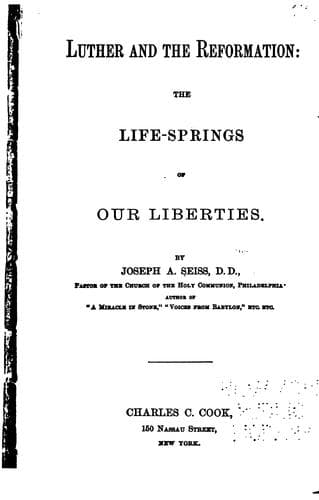
Luther and the Reformation:: The Life-Springs of Our LibertiesSeiss, Joseph Augustus
History
Luther and the Reformation:: The Life-Springs of Our Liberties
Seiss, Joseph Augustus
Luther, Martin, 1483-1546; Pennsylvania -- History -- Colonial period, ca. 1600-1775
When Gustavus Adolphus fell at Luetzen a sacrifice to religious
liberty, the whole administration of the kingdom was placed in
Oxenstiern's hands. The congress of foreign princes at Heilbronn
elected him to the headship of their league against the papal power of
Austria; and it was his wisdom and heroism alone which held the league
together unto final triumph. Bauer, Torstensson, and Von Wrangle were
the flaming swords which finally overwhelmed that power, but the brain
which brought the fearful Thirty Years' War to a final close, and
established the evangelical cause upon its lasting basis of security
by the Peace of Westphalia (1648), was that of Axel Oxenstiern, the
very man who sent to Pennsylvania its original colonists as the
founders of a free state.
PETER MINUIT.
A kindred spirit was PETER MINUIT, the man whom Oxenstiern
selected and commissioned to accompany these first colonists to the
west bank of the Delaware, and to act as their president and governor.
He too was a high-born, cultured, large-minded Christian man. He was
an honored deacon in the Walloon church at Wesel. Removing to Holland,
his high qualities led to his selection by the Dutch West India
Company as the fittest man to be the first governor and
director-general of the Dutch colonies on the Hudson. His great
efficiency and public success in that capacity made him the subject of
jealousies and accusations, resulting in his recall after five or six
years of the most effective administration of the affairs of those
colonies. Oxenstiern had the breadth and penetration to understand his
real worth, and appointed him the first governor of the New Sweden
which since has become the great State of Pennsylvania. He lived less
than five years in this new position, and died in Fort Christina,
which he built and held during his last years of service on earth. He
was a wise, laborious, and far-seeing man, consecrated with all his
powers to the formation of a free commonwealth on this then wild
territory. His name has largely sunk away from public attention, as
the work of the Swedes in general in the founding and fashioning of
our commonwealth; but he and they deserve far better than has been
awarded them.
A few years ago (1876) some movement was for the first time made to
erect a suitable monument to the memory of Minuit. Surely the founder
of the greatest city in this Western World, and of the colonial
possessions of two European nations, and the first president and
governor of the two greatest States in the American Union, ranks among
the great historic personages of his period; and his high qualities,
noble spirit, and valuable services demand for him a grateful
recognition which has been far too slow in coming. There is a debt
owing to his name and memory which New York, Pennsylvania, and the
American people have not yet duly discharged.
And to these grand men, first of all, are we under obligation of
everlasting thanks for our free and happy old commonwealth.
Public-domain text, read in full here on John Shaqi.
Reviews
Reviews
No reviews yet
Be the first to share your thoughts on this work.
Elsewhere in the archive
Join the Discussion
Join the discussion
Sign in to leave a comment or review.
Sign InorCreate an account