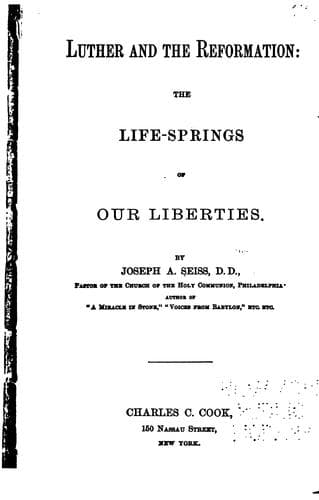
Luther and the Reformation:: The Life-Springs of Our LibertiesSeiss, Joseph Augustus
History
Luther and the Reformation:: The Life-Springs of Our Liberties
Seiss, Joseph Augustus
Luther, Martin, 1483-1546; Pennsylvania -- History -- Colonial period, ca. 1600-1775
II. Accordingly, also, the chief corner-stone in the constitutional
fabric of our State was the united official acknowledgment of the
being and supremacy of one eternal and ever-living God, the Judge of
all men and the Lord of nations.
The self-existence and government of Almighty God is the foundation of
all things. Nothing _is_ without him. And the devout and dutiful
recognition of him and the absolute supremacy of his laws are the
basis and chief element of everything good and stable in human
affairs. He who denies this or fails in its acknowledgment is so far
practically self-stultified, beside himself, outside the sphere of
sound rationality, and incapable of rightly understanding or directing
himself or anything else. Nor could those who founded our commonwealth
have been moved as they were, or achieved the happy success they did,
had it not been for their clear, profound, and practical
acknowledgment of the being and government of that good and almighty
One who fills immensity and eternity, and from whom, and by whom, and
to whom are all things.
Some feel and act as if it were an imbecility, or a thing only for the
weak, timid, and helpless, to be concerned about an Almighty God. But
greater, braver, and more manly men did not then exist than those who
were most prominent and active in founding and framing our
commonwealth; and of all men then making themselves felt in the
affairs of our world, they were among the most honest and devout in
the practical confession of the eternal being and providence of
Jehovah.
The great Gustavus Adolphus and the equally great Axel Oxenstiern held
and confessed from their deepest souls and in all their thoughts and
doings that there is an eternal God, infinite in power, wisdom, and
goodness, the Creator, Preserver, and Judge of all things, visible and
invisible, and that on him and his favor alone all good and
prosperity in this world and the next depends. This they ever formally
and devoutly set forth in all their state papers and in all their
undertakings and doings, whether as men or as rulers. The sound of
songs and prayers to this almighty and ever-present God was heard at
every sunrise through all the army of Gustavus in the field, as well
as in the tent and closet of its great commander. And all the
instructions given to the governors of the colony on the Delaware were
meekly conditioned to the will of God, with specific emphasis on the
provision: "Above all things, shall the governor consider and see to
it that a true and due worship, becoming honor, laud, and praise be
paid to the Most High in all things."
Public-domain text, read in full here on John Shaqi.
Reviews
Reviews
No reviews yet
Be the first to share your thoughts on this work.
Elsewhere in the archive
Join the Discussion
Join the discussion
Sign in to leave a comment or review.
Sign InorCreate an account