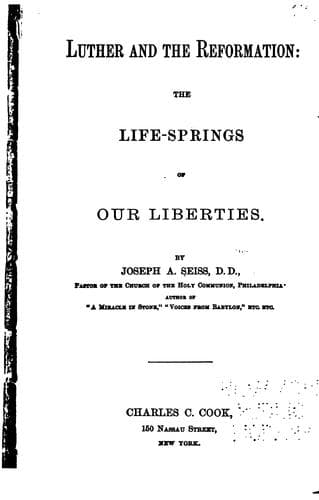
Luther and the Reformation:: The Life-Springs of Our LibertiesSeiss, Joseph Augustus
History
Luther and the Reformation:: The Life-Springs of Our Liberties
Seiss, Joseph Augustus
Luther, Martin, 1483-1546; Pennsylvania -- History -- Colonial period, ca. 1600-1775
On the other hand, the state is bound for the same reasons to protect
and defend religion in general and the cultivation of the religious
sentiments, in so far, at least, as the laws of virtue and order are
not transgressed in the name of religion. It may not interfere to
decide between different religious societies or churches, as they may
be equally conscientious and honest in their diversities; but where
the tendency is to good and reverence, and the training of the
community to right and orderly life, it belongs to the office and
being of the state not only to tolerate, but to protect them all
alike. In the fatherly care of its subjects, the people consenting,
the state may also recommend and provide support for some particular
and approved order of faith and worship, just as it provides for
public education. And though the civil power may not rightfully
punish, fine, imprison, and oppress orderly and honest citizens for
conscientious non-conformity to any one specific system of belief and
worship, it may, and must, provide for and protect what tends to its
rightful conservation, and also condemn, punish, and restrain
whatsoever tends to unseat it and undermine its existence and peace.
These are fundamental requirements in all sound political economy.
LAWS ON RELIGION AND MORALS.
Our fathers, in their wisdom, understood this, and fashioned their
state provisions and laws accordingly.
The thing specified as the supreme concern of the public authorities
in the original settlement of this territory by the Swedes was, to
"consider and see to it that a true and due worship, becoming honor,
laud, and praise be paid to the most high God in all things," and that
"all persons, but especially the young, shall be duly instructed in
the articles of their Christian faith."
But if public worship and religious instruction are to be fostered and
preserved by the state, there must be set times for it, the people
released at those times from hindering occupations and engagements,
and whatever may interfere therewith restrained and put under bonds
against interruption. In other words, the Lord's proper worship
demands and requires a protected Lord's Day. Such appointed and sacred
times for these holy purposes have been from the foundation of the
world. Under all dispensations one day in every seven was a day unto
the Lord, protected and preserved for such sacred uses, on which
secular occupations should cease, and nothing allowed which would
interfere with the public worship of Almighty God and the handling of
his Word. And "because it was requisite to appoint a certain day, that
the people might know when they ought to come together, it appears
that the Christian Church [and so all Christian states] did for that
purpose appoint the Lord's Day," our weekly Sunday.
Public-domain text, read in full here on John Shaqi.
Reviews
Reviews
No reviews yet
Be the first to share your thoughts on this work.
Elsewhere in the archive
Join the Discussion
Join the discussion
Sign in to leave a comment or review.
Sign InorCreate an account