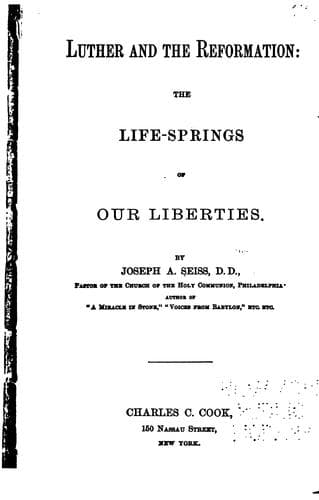
Luther and the Reformation:: The Life-Springs of Our LibertiesSeiss, Joseph Augustus
History
Luther and the Reformation:: The Life-Springs of Our Liberties
Seiss, Joseph Augustus
Luther, Martin, 1483-1546; Pennsylvania -- History -- Colonial period, ca. 1600-1775
There is nothing necessarily wrong or necessarily right in this
particular. Monarchy, aristocracy, republicanism, or pure democracy
cannot claim divine right the one over against the other. Either may
be good, or either may be bad, as the situation and the chances may
be. There has been as much bloody wrong and ruin wrought in the name
of liberty as in the establishment of thrones. There have been as good
and happy governments by kings as by any other methods of human
administration. Civil authority is essential to man, and the power for
it must lie somewhere. The only question is as to the safest
depository of it. The mere form of the government is no great matter.
It has been justly said, "There is hardly a government in the world so
ill designed that in good hands would not do well enough, nor any so
good that in ill hands can do aught great and good." Governments
depend on men, not men on governments. Let men be good, and the
government will not be bad; but if men are bad, no government will
hold for good. If government be bad, good men will cure it; and if the
government be good, bad men will warp and spoil it. Nor is there any
form of government known to man that is not liable to abuse,
prostitution, tyranny, unrighteousness, and oppression.
The best government is that which most efficiently conserves the true
ends of government, be the form what it may. Anything differing from
this is worthless sentimentalism, undeserving of sober regard. And to
meet the true ends of government there must be power to enforce
obedience, and there must be checks upon that power to secure its
subjects against its abuse; for "liberty without obedience is
confusion, and obedience without liberty is slavery." But there may be
liberty under monarchy, as well as reverence and obedience under
democracy, whilst there may be oppression and bloody tyranny under
either.
Amid the varied experiments of the ages the human mind is more and
more settling itself in favor of mixed forms of government, in which
the rights of the people and the limitations of authority are set down
in fixed constitutions, taking the direct rule from the multitude, but
still holding the rulers accountable to the people. Such were more or
less the forms under which the founders of our commonwealth were
tutored.
A REPUBLICAN STATE.
But they went a degree further than the precedents before them. They
believed the safest depository of power to be with the people
themselves, under constitutions ordained by those intending to live
under them and administered by persons of their own choice. "Where
the laws rule, and the people are a party to those laws," was believed
to be the true ideal and realization of civil liberty--the way "to
support power in reverence with the people, and to secure the people
from the abuse of power, that they may be free by their just
obedience, and the magistrates honorable for their just
administration."
Public-domain text, read in full here on John Shaqi.
Reviews
Reviews
No reviews yet
Be the first to share your thoughts on this work.
Elsewhere in the archive
Join the Discussion
Join the discussion
Sign in to leave a comment or review.
Sign InorCreate an account