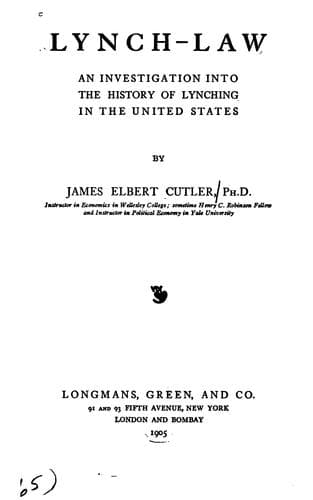
Lynch-law; an investigation into the history of lynching in the United StatesCutler, James Elbert
Philosophy
Lynch-law; an investigation into the history of lynching in the United States
Cutler, James Elbert
Lynching -- United States
Willcox, Walter F., 207.
Williams, George W., 199, 203.
Williamson, Hugh, 20, 48, 50.
Wilson, D. L., 139.
Wilson, Woodrow, 107.
Wirt, William, 26, 32, 71.
Wisconsin, lynch-law adopted, 152, 180, 185.
Wister, Owen, 197.
Women, lynching of, 172, 173.
Wright, Carroll D., 268.
Wyoming, lynch-law adopted, 180, 184;
punishment of lynchers, 255.
-----
Footnote 1:
Compare statement by William Roberts in _Fortnightly Review_, January,
1892 (57: 92).
Footnote 2:
The _Times_, Washington, D. C., Dec. 14, 1902.
Footnote 3:
The _Standard Union_, Brooklyn, N. Y., Nov. 14, 1902.
Footnote 4:
The _New York Evening Telegraph_, Oct. 8, 1902.
Footnote 5:
See F. Ratzel: “History of Mankind” (trans. by A. J. Butler), I, 125,
281, 282; II, 131; III, 507.
Footnote 6:
See “Fehmic courts,” Encyclopædia Britannica, 9th edition.
Footnote 7:
Edward Phillips: “The New World of Words, or a General English
Dictionary” (1678, 4th edition).
Footnote 8:
Grose’s “Provincial Glossary” (London, 1811), p. 163.
Footnote 9:
See “Lynch Law,” International Cyclopædia (1893).
Footnote 10:
See Century Dictionary under “Law.”
Footnote 11:
John Jamieson: “Etymological Dictionary of the Scottish Language”
(1879).
Footnote 12:
An American edition, bound under the title, “Brande’s Encyclopædia,”
was published in 1843.
Footnote 13:
The English Dictionary, edited by Rev. John Boag and published at
Glasgow in 1848, gives for the verb lynch, “To inflict punishment
without the forms of law, as by a mob.” The definitions given for the
words “lynched” and “lynching” are also very similar to the ones given
by Webster. It is fair to presume that Boag consulted Webster and
followed his authority, although he did not mark the term as an
American word. John Craig’s Dictionary of the English Language
(London, 1849) gives “lynch, _v. a._ To punish summarily without
judicial investigation, as by a mob.—An American word.” The London
edition of Nuttall’s Dictionary (published about 1863) gives “Lynch,
_v. a._ To inflict pain, or punish without the forms of law, as by an
American mob.” The dictionaries published in Great Britain previous to
1848 do not contain the verb lynch.
Footnote 14:
The edition of 1901 has the same. The Century Dictionary is the only
recent authoritative work that states unequivocally that lynch-law was
originally the kind of law administered by Charles Lynch of Virginia.
Footnote 15:
See Hardiman’s History of Galway (Dublin, 1820), p. 70. Also,
_Spectator_ (London), April 13, 1889 (62: 511). The story can be
traced back as far as the year 1674. See Miscellany of the Irish
Archæological Society (1846), I, 44–80. (M.)
Footnote 16:
The _Green Bag_, March, 1900 (12: 150).
Footnote 17:
Public-domain text, read in full here on John Shaqi.
Reviews
Reviews
No reviews yet
Be the first to share your thoughts on this work.
Elsewhere in the archive
Join the Discussion
Join the discussion
Sign in to leave a comment or review.
Sign InorCreate an account