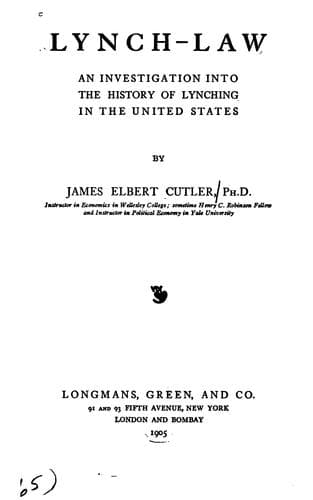
Lynch-law; an investigation into the history of lynching in the United StatesCutler, James Elbert
Philosophy
Lynch-law; an investigation into the history of lynching in the United States
Cutler, James Elbert
Lynching -- United States
Compare the justification of the frontier type of lynch-law given by
Owen Wister in his recent novel, “The Virginian.” After describing the
lynching of some Wyoming cattle-thieves, and emphasizing the fact that
“many an act that man does is right or wrong according to the time and
place which form, so to speak, its context,” the author puts into the
mouth of “Judge Henry” these words: “They (the ordinary citizens) are
where the law comes from, you see. For they chose the delegates who
made the Constitution that provided for the courts. There’s your
machinery. These are the hands into which ordinary citizens have put
the law. So you see, at best, when they lynch they only take back what
they once gave.... We are in a very bad way, and we are trying to make
that way a little better until civilization can reach us. At present
we lie beyond its pale. The courts, or rather the juries, into whose
hands we have put the law, are not dealing the law. They are withered
hands, or rather they are imitation hands made for show, with no life
in them, no grip. They cannot hold a cattle-thief. And so when your
ordinary citizen sees this, and sees that he has placed justice in a
dead hand, he must take justice back into his own hands where it was
once at the beginning of all things. Call this primitive, if you will,
but so far from being a _defiance_ of the law, it is an _assertion_ of
it—the fundamental assertion of self-governing men, upon whom our
whole social fabric is based.”—pp. 435–436.
Footnote 229:
C. A. Murray: “Travels in America” (1839), II, 81.
Footnote 230:
Bancroft’s justification of popular tribunals and vigilance societies
has been referred to above. See Chapter IV, p. 133.
Footnote 231:
“History of the Negro Race in America” (1883), I, 121, 131.
Footnote 232:
See J. A. Tillinghast: “The Negro in Africa and America”—Publications
of the American Economic Association, May, 1902 (3d Ser., Vol. III,
No. 2). This monograph presents an admirable historical perspective of
the native characteristics and of the acquirements of the colored race
in America.
Footnote 233:
Fanny Kemble, writing in 1838–39, attributed the “personal
offensiveness” of negroes to dirt and habits of uncleanliness,
asserting that the negroes had no respect for their personal
appearance, and that this lack of respect was due to slavery. In her
journal, these words are found: “The stench in an Irish, Scotch,
Italian, or French hovel are quite as intolerable as any I ever found
in any of our negro houses.” In another connection, however, when
describing a certain negro named Isaac, she refers particularly to his
strong physical resemblance to a monkey, and says that she is much
comforted by the fact that this individual “_speaks_.” See “Journal of
a Residence on a Georgian Plantation” (1863), pp. 23–24, 219.
Public-domain text, read in full here on John Shaqi.
Reviews
Reviews
No reviews yet
Be the first to share your thoughts on this work.
Elsewhere in the archive
Join the Discussion
Join the discussion
Sign in to leave a comment or review.
Sign InorCreate an account