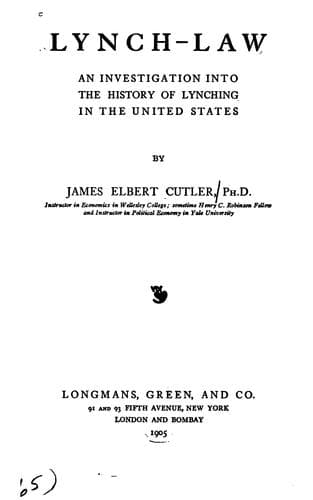
Lynch-law; an investigation into the history of lynching in the United StatesCutler, James Elbert
Philosophy
Lynch-law; an investigation into the history of lynching in the United States
Cutler, James Elbert
Lynching -- United States
A like opinion is expressed by many writers. See, for example,
_Forum_, October, 1898 (16: 167); _Outlook_, Oct. 31, 1903 (75: 493);
_Outlook_, Dec. 26, 1903 (75: 984).
Footnote 244:
For a number of references on the subject of rape and its punishment,
and also on the subject of burning alive as a legal punishment for
crime, during the colonial period, the writer is indebted to Mr.
Albert Matthews.
Footnote 245:
“Acts of Assembly of the Province of Pennsylvania” (1775), pp. 45–46.
On May 5, 1722, it became the law of Pennsylvania that importers of
servants who have been convicted of rape must pay a duty and enter
security for good behavior for one year.—Statutes at Large of
Pennsylvania, III, 264.
Footnote 246:
Colonial Laws of New York, I, 765–766.
Compare law of Aug. 8, 1688, in the Island of Barbadoes, which
provided that two justices and three freeholders were to “give
sentence of Death upon” negroes, for murder, rape, burning houses,
&c.—Acts of Assembly Passed in the Island of Barbadoes, From 1648, to
1718 (1721), pp. 140–141.
Footnote 247:
Laws of the State of Delaware (1797), I, 102–105.
By an act passed in January, 1797, thirty-nine lashes well laid on
were added to the punishment for an attempted rape on a white woman or
maid.—Laws of the State of Delaware (1797), II, 1321–1324.
Footnote 248:
Laws of Maryland (1799), Chapter XIV.
Footnote 249:
See John S. Bassett: “Slavery and Servitude in the Colony of North
Carolina”—Johns Hopkins Historical Studies (1896), XIV, 199. In
Virginia the punishment of castration was so frequently inflicted upon
slaves by the county courts that the Assembly deemed it necessary to
enact that “it shall not be lawful for any county or corporation
court, to order and direct castration of any slave, except such slave
shall be convicted of an attempt to ravish a white woman, in which
case they may inflict such punishment.”—See Hening: “Virginia Statutes
at Large,” VI, 3; VIII, 358; Samuel Sheperd: “Virginia Statutes at
Large” (New Series, 1835), I, 125.
Footnote 250:
“Records of the Court of Assistants of the Colony of the Massachusetts
Bay” (J. Noble, 1901), p. 74.
The following passage is taken from the _Boston Chronicle_, Sept.
26–Oct. 3, 1768 (No. 42, I, 383): “We hear that a negro fellow was
tried at the Assizes held lately at Worcester, for a rape, and found
guilty, and received sentence of death.—A white man was also tried and
found guilty of the same crime, and sentenced to sit on the gallows.”
Footnote 251:
See “Proceedings of the New Jersey Historical Society” (1874), 2d
Series, III, 178.
Footnote 252:
See J. R. Brackett: “The Negro in Maryland” (1889), p. 131.
Footnote 253:
_Pennsylvania Gazette_, Dec. 14, 1744 (N. J. _Archives_, XII, 244).
Footnote 254:
Public-domain text, read in full here on John Shaqi.
Reviews
Reviews
No reviews yet
Be the first to share your thoughts on this work.
Elsewhere in the archive
Join the Discussion
Join the discussion
Sign in to leave a comment or review.
Sign InorCreate an account