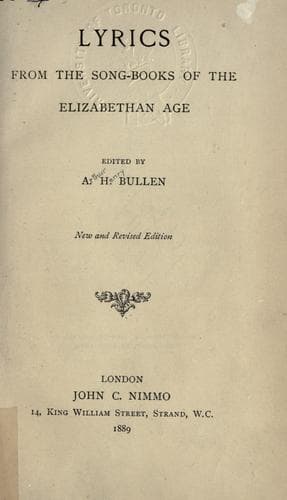
Ballads, English -- Texts; English poetry -- Early modern, 1500-1700; Songs, English -- England -- Texts
Charge it again, boy, charge it again,
_Pardona moy je vous an pree_,
As long as there is any ink in thy pen,
With never a penny of money.
From _Deuteromelia_, 1609.
We be three poor mariners,
Newly come from the seas;
We spend our lives in jeopardy
While others live at ease.
Shall we go dance the round, the round,
Shall we go dance the round?
And he that is a bully boy
Come pledge me on this ground!
We care not for those martial men
That do our states disdain;
But we care for the merchant men
Who do our states maintain:
To them we dance this round, around,
To them we dance this round;
And he that is a bully boy
Come pledge me on this ground!
From _Egerton MS., 2013_.
We must not part as others do,
With sighs and tears, as we were two:
Though with these outward forms we part,
We keep each other in our heart.
What search hath found a being, where
I am not, if that thou be there?
True love hath wings, and can as soon
Survey the world as sun and moon,
And everywhere our triumphs keep
O'er absence which makes others weep:
By which alone a power is given
To live on earth, as they in heaven.
From THOMAS WEELKES' _Ballets and Madrigals to Five Voices_, 1598.
We shepherds sing, we pipe, we play,
With pretty sport we pass the day:
Fa la!
We care for no gold,
But with our fold
We dance
And prance
As pleasure would.
Fa la!
From WILLIAM BYRD's _Psalms, Songs, and Sonnets_, 1611.
Wedded to will is witless,
And seldom he is skilful
That bears the name of wise and yet is wilful.
To govern he is fitless
That deals not by election,
But by his fond affection.
O that it might be treason
For men to rule by will and not by reason.
From THOMAS TOMKINS' _Songs of Three, Four, Five, and Six Parts_, 1622.
Weep no more, thou sorry boy;
Love's pleased and anger'd with a toy.
Love a thousand passion brings,
Laughs and weeps, and sighs and sings.
If _she_ smiles, he dancing goes,
And thinks not on his future woes:
If _she_ chide with angry eye,
Sits down, and sighs "Ah me, I die!"
Yet again, as soon revived,
Joys as much as late he grieved.
Change there is of joy and sadness,
Sorrow much, but more of gladness.
Then weep no more, thou sorry boy,
Turn thy tears to weeping joy.
Sigh no more "Ah me! I die!"
But dance, and sing, and ti-hy cry.
From JOHN ROWLAND's _Third and Last Book of Songs or Airs_, 1603.
Weep you no more, sad fountains;
What need you flow so fast?
Look how the snowy mountains
Heaven's sun doth gently waste!
But my sun's heavenly eyes,
View not your weeping,
That now lies sleeping
Softly, now softly lies
Sleeping.
Public-domain text, read in full here on John Shaqi.
Reviews
Reviews
No reviews yet
Be the first to share your thoughts on this work.
Elsewhere in the archive
Join the Discussion
Join the discussion
Sign in to leave a comment or review.
Sign InorCreate an account