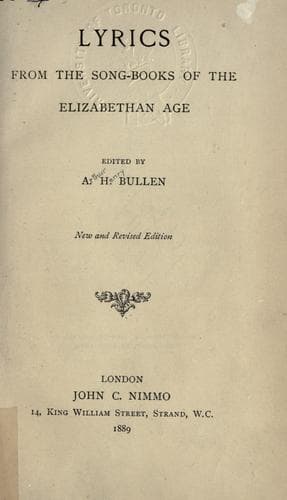
Ballads, English -- Texts; English poetry -- Early modern, 1500-1700; Songs, English -- England -- Texts
Fear not, the ground seeks but to kiss thy feet;
Hark, hark, how Philomela sweetly sings!
Whilst water-wanton fishes as they meet
Strike crotchet time amidst these crystal springs,
And Zephyrus amongst the leaves sweet murmur rings.
Stay but awhile, Ph[oe]be no tell-tale is;
She her Endymion, I'll my Ph[oe]be kiss.
See how the helitrope, herb of the sun,
Though he himself long since be gone to bed,
Is not of force thine eye's bright beams to shun,
But with their warmth his goldy leaves unspread,
And on my knee invites thee rest thy head.
Stay but awhile, Ph[oe]be no tell-tale is;
She her Endymion, I'll my Ph[oe]be kiss.
From WILLIAM BYRD's _Psalms, Sonnets, and Songs_, 1588.
Who likes to love, let him take heed!
And wot you why?
Among the gods it is decreed
That Love shall die;
And every wight that takes his part
Shall forfeit each a mourning heart.
The cause is this, as I have heard:
A sort of dames,
Whose beauty he did not regard
Nor secret flames,
Complained before the gods above
That gold corrupts the god of love.
The gods did storm to hear this news,
And there they swore,
That sith he did such dames abuse
He should no more
Be god of love, but that he should
Both die and forfeit all his gold.
His bow and shafts they took away
Before his eyes,
And gave these dames a longer day
For to devise
Who should them keep, and they be bound
That love for gold should not be found.
These ladies striving long, at last
They did agree
To give them to a maiden chaste,
Whom I did see,
Who with the same did pierce my breast:
Her beauty's rare, and so I rest.
From WILLIAM BYRD's _Songs of Sundry Natures_, 1589.
1. Who made thee, Hob, forsake the plough
And fall in love?
2. Sweet beauty, which hath power to bow
The gods above.
1. What dost thou serve? 2. A shepherdess;
One such as hath no peer, I guess.
1. What is her name who bears thy heart
Within her breast?
2. Silvana fair, of high desert,
Whom I love best.
1. O, Hob, I fear she looks too high.
2. Yet love I must, or else I die.
From THOMAS BATESON's _First Set of English Madrigals_, 1604.
Who prostrate lies at women's feet.
And calls them darlings dear and sweet;
Protesting love, and craving grace,
And praising oft a foolish face;
Are oftentimes deceived at last,
Then catch at nought and hold it fast.
From JOHN FARMER's _First Set of English Madrigals_, 1599.
Who would have thought that face of thine
Had been so full of doubleness,
Or that within those crystal eyn
Had been so much unstableness?
Thy face so fair, thy look so strange!
Who would have thought of such a change?
Public-domain text, read in full here on John Shaqi.
Reviews
Reviews
No reviews yet
Be the first to share your thoughts on this work.
Elsewhere in the archive
Join the Discussion
Join the discussion
Sign in to leave a comment or review.
Sign InorCreate an account