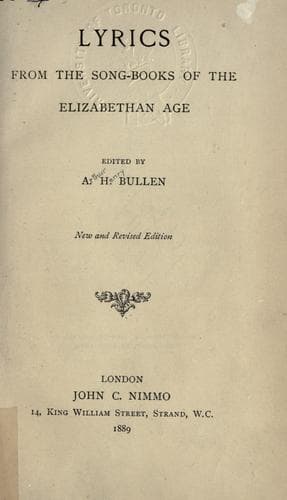
Ballads, English -- Texts; English poetry -- Early modern, 1500-1700; Songs, English -- England -- Texts
In Morley's "Canzonets to three Voices," 1593, we have the following
pleasant description of the preparations for a country wedding:--
"Arise, get up, my dear, make haste, begone thee:
Lo! where the bride, fair Daphne, tarries on thee.
Hark! O hark! yon merry maidens squealing
Spice-cakes, sops-in-wine are a-dealing.
Run, then run apace
And get a bride-lace
And gilt rosemary branch the while there yet is catching
And then hold fast for fear of old snatching.
Alas! my dear, why weep ye?
O fear not that, dear love, the next day keep we.
List, yon minstrels! hark how fine they firk it,
And how the maidens jerk it!
With Kate and Will,
Tom and Gill,
Now a skip,
Then a trip,
Finely fet aloft,
There again as oft;
Hey ho! blessed holiday!
All for Daphne's wedding day!"
_Page_ 9. John Wilbye is styled by Oliphant "the first of madrigal
writers." He published his "First Set of English Madrigals" in 1598, and
his "Second Set" in 1609. The Second Set was dedicated to the
unfortunate Lady Arabella Stuart. The composer concludes his dedicatory
epistle with the prayer, "I beseech the Almighty to make you in all the
passages of your life truly happy, as you are in the world's true
opinion, virtuous." In the very year when the epistle was written the
gifted patroness of art and learning was accused before the Privy
Council and ordered to be kept in close confinement. She made her
escape, but after a few hours was captured at sea in her flight to
Dunkirk, brought back to London, and committed to the Tower, where she
died of a broken heart in 1615. It is pleasant to think that the
song-book dedicated to her honour may have cheered her in the long hours
of solitude. The collection consists chiefly of love-lyrics; but such
verses as "Happy, O happy he," &c. (p. 37) and "Draw on, sweet Night"
(p. 21), must have been carefully cherished by the poor captive.
_Page_ 9. "April is in my mistress' face."--Compare Robert Greene's
verses in "Perimedes, the Blacksmith," 1588:--
"Fair is my love, for April in her face,
Her lovely breasts September claims his part,
And lordly July in her eyes takes place:
But cold December dwelleth in her heart:
Blest be the months that set my thoughts on fire,
Accurs'd that month that hindereth my desire!"
_Page_ 11. "The Urchins' Dance" is from the anonymous play "The Maid's
Metamorphosis," 1600. In the same play are the following dainty
verses;--
"_1 Fairy._ I do come about the copse
Leaping upon flowers' tops;
Then I get upon a fly,
She carries me above the sky,
And trip and go!
_2 Fairy._ When a dew-drop falleth down
And doth light upon my crown,
Then I shake my head and skip
And about I trip.
Public-domain text, read in full here on John Shaqi.
Reviews
Reviews
No reviews yet
Be the first to share your thoughts on this work.
Elsewhere in the archive
Join the Discussion
Join the discussion
Sign in to leave a comment or review.
Sign InorCreate an account