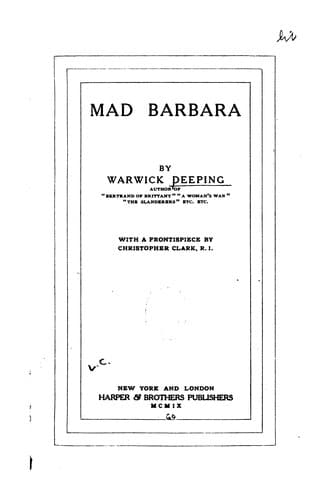
Great Britain -- History -- Charles II, 1660-1685 -- Fiction
They were close to the open gate at the moment, and John Gore took
Barbara by the hand and drew her aside along the wall to where a stunted
bush had made roots and grown despite the stones. He pressed Barbara
back within its shadow, and stood covering her, a pistol ready and the
hanger at his belt should he need cold steel.
“Not a sound, Barbe; be ready to slip away when I take your hand.”
They could hear the steady thud of hoofs over the grass, and even the
heavy breathing of the beast, as though he had been pushed and bustled
by the spur. John Gore guessed that his rider was skirting along the
moat. Then came the sharper clatter of the iron shoes upon the timbers
of the bridge. The dog set up a savage barking, and in the moonlight
they saw a man ride into the court of Thorn, steam rising from his horse
like smoke, so that the beast looked huge and spectral. The man himself,
though outlined against the moon, showed nothing but the sweep of a
cloak and the droop of a black beaver.
He sat motionless a moment in the saddle, and then, dismounting, led his
horse by the bridle toward the mist of light that came from the archway
leading into the kitchen. John Gore felt for Barbara’s hand, and they
glided along the wall toward the gate, for the man’s back was toward
them, while the barking of the dog and his grinding against the chain
drowned the sound of their footsteps utterly. They made the gate, and
went out hand in hand over the bridge and away over the moonlit
grass-land, with the barking of the dog dying down into a hoarse
whimper. John Gore had thrust the pistol in his belt and swung the sack
over his left shoulder. He put his right arm about Barbara’s body and
swept her along by main strength toward the towering beech-trees that
shone in the moonlight while the seal of silence seemed over Thorn.
XXXIX
It was Stephen Gore who had ridden that steaming horse into the
court-yard of Thorn—Stephen Gore, with jaded, twitching face, and eyes
that looked weary with straining and gazing into the deeps of the night.
No man can be constantly and statuesquely selfish through life; the very
whims and impulses of human nature are against such a frozen constancy
in self-seeking. Nor can a man ever swear to being master either of
himself or of his future; the whole gamut of the emotions are arrayed
against him; a child may prove his vanquisher or a woman his seducer.
Public-domain text, read in full here on John Shaqi.
Reviews
Reviews
No reviews yet
Be the first to share your thoughts on this work.
Elsewhere in the archive
Join the Discussion
Join the discussion
Sign in to leave a comment or review.
Sign InorCreate an account