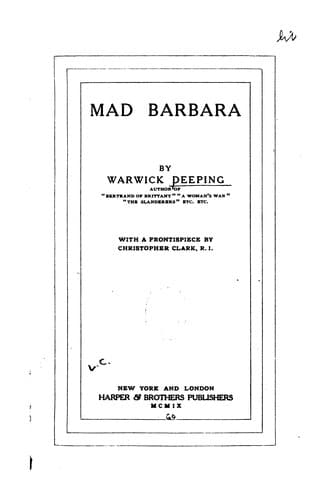
Great Britain -- History -- Charles II, 1660-1685 -- Fiction
The glow of the winter fires reddened the windows of Furze Farm as the
shadow of the house loomed up through the mist. The orchard hedge was
dripping with dew, the grass gray and sodden, the beech-trees like
phantom trees, the coming of the dusk mournful and full of a heavy
silence. Yet the windows of the house, with their lozenged latticing
outlined by the fire, sent John Gore’s thoughts back with a sudden
shiver of pity to dreary, ruinous, fog-choked Thorn. He dismounted
heavily, and leading his horse to the stable left him to Mr. Jennifer,
who was sitting astride a rough bench mending harness by the light of a
candle.
In the kitchen Barbara came out to welcome him, with just the faintest
glimmer of shyness that made her love the more desirable. Mrs. Winnie
was above, turning out her linen cupboard, little Will in the wood-lodge
cutting firewood with the hand-bill—a thing he had been solemnly
forbidden to do. Barbara and John had both kitchen and parlor to
themselves. No candles had been lit in the house as yet, but the burning
logs threw a rich light upon the wainscoting.
“You have had a long ride, John.”
He hung his cloak on a chair and took her hands, her pale face with its
new ripeness of color seeming to bring to him freshness and perfume
after these abhorrent hours at Thorn. Yet his heart was stern and
troubled in him because of the man, his father; nor could even his
love’s eyes flash a complete smile into his.
“They will be pleased with this fog at sea,” he said. “I can fancy that
I hear the bells ringing. What have you been doing all day, little
woman?”
She looked at him with questioning intentness. Rarely can a man hide
care from the world—very rarely, indeed, from the eyes of the woman who
loves him.
“Mrs. Winnie has been teaching me to make button-holes, John. Will and I
went out after dinner, and were nearly lost in the fog. You look tired.”
He had dropped her hands, but he caught them again with the impulsive
frankness of a man who knows himself to be but a poor dissembler.
“I am tired, Barbe—heart-tired; I cannot pretend that I am not.”
“John!”
Her voice had a touch of appeal in it.
“This morning I went out innocently enough, child; but I have returned
with more than I foreshadowed.”
“Where have you been, John?”
“To Thorn.”
“Thorn!”
“Yes.”
She hung back a little from him, reading the forethought and trouble in
his eyes, and the tired yet generous calm of a man thinking of others
rather than himself.
“You are troubled, John. Tell me.”
He looked down at her reflectively, and his eyes seemed to say: “Shall I
or shall I not?” Womanwise, she appeared to understand.
“You are afraid for my sake, John.”
“A little.”
“Is it because you cannot trust me?”
Her eyes held his, and for once it was as though she had the greater
power of will.
“No. Because I wish worry and care away.”
“John, do you think I shall leave all the burden of life to your
shoulders? Are we so little to each other? Am I so selfish?”
Public-domain text, read in full here on John Shaqi.
Reviews
Reviews
No reviews yet
Be the first to share your thoughts on this work.
Elsewhere in the archive
Join the Discussion
Join the discussion
Sign in to leave a comment or review.
Sign InorCreate an account