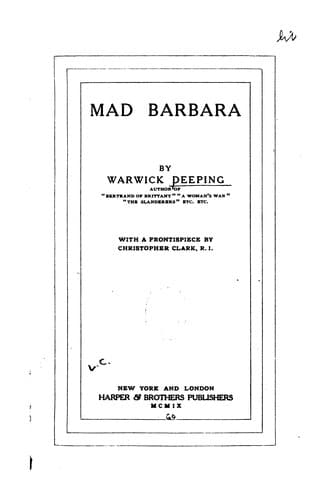
Great Britain -- History -- Charles II, 1660-1685 -- Fiction
John Gore had made a rough splint and bound his father’s leg to it, and
contrived a bed with straw and blankets that should keep him from sores
and from the cold. A spark of my lord’s easy cynicism had flashed out
momentarily in the midst of his degradation.
“Mending a leg to break a neck, John; you are Puritan enough for that.”
But it was a flash in the pan. Even the polite insolence seemed dead in
him. He had caught his son’s arm and clung to it pleadingly.
“Think better of me, John. I came here to save the girl: I swear that,
before God.”
And then he would show great cunning behind the chatterings of dismay,
trying to worm from his son all that he knew, and also how he had come
to know it. But John Gore kept a shut mouth and the face of a flint, the
heart hard and contemptuous within him when he remembered the look in
Barbara’s eyes when she had spoken these words: “I can forgive.” Surely
there was no soul here worth forgiving. Better dead. That was the grim
judgment his heart uttered.
Such was the first week at Thorn, with the dark rides to and fro along
the woodland roads, the mournfulness and dolor of the winter landscape,
love by the fireside, retribution amid ruins. Sometimes Barbara would
walk out a little way toward Thorn in the hope of meeting John Gore upon
the homeward ride. She could not but mark the bitterness in him, a
certain questioning look about the eyes that seemed to gaze toward some
inevitable end. The riddle would have been baffling enough even if his
heart had been in the solving of it. Granted that the past were given to
oblivion, his father was a proscribed man; there was some risk even in
shielding him; any day he might be discovered and taken.
Nor could he tell Barbara all that he saw at Thorn. It was too sordid,
too contemptible; and yet his very reticence led her to understand.
Perhaps she had more sympathy, more vision than John Gore that winter.
She knew what Thorn could be even to one without guilt, without physical
pain, without an eternal dread, and with some one to bring food. This
man had gone down into the deeps of misery and degradation. He had been
starved and broken. That was her thought.
Once she asked John Gore to let her see him, but he shook his head and
would not hear of it.
“He thinks that I am dead, John,” she said.
“Then let him think it. God! Are we to make the thing so easy?”
“John! John!”
His fierceness hurt her a little, seeming to wake a clash of discords in
her, as though the brazen gates of that closed tragedy were jarring wide
again.
“John, don’t speak like that, dear.”
His tenderness shone through the anger in him.
“Barbe, you may forget; I cannot. When I touch your hand, when I see the
life in you, I remember.”
The memory of that night came back, and she shuddered: the dark room,
those throttling hands, the violence and horror in the dark. She looked
at her lover and understood.
“It is hard for you,” she said, very gently.
Public-domain text, read in full here on John Shaqi.
Reviews
Reviews
No reviews yet
Be the first to share your thoughts on this work.
Elsewhere in the archive
Join the Discussion
Join the discussion
Sign in to leave a comment or review.
Sign InorCreate an account