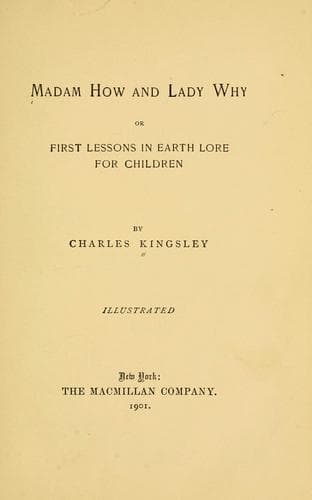
Madam How and Lady Why; Or, First Lessons in Earth Lore for ChildrenKingsley, Charles
History
Madam How and Lady Why; Or, First Lessons in Earth Lore for Children
Kingsley, Charles
Geology -- Juvenile literature; Natural history -- Juvenile literature
a year, till both made peace, and lived quietly side by side for ages.
Another forest coming up from below? Where would it come from?
From where it is now. Come down and look along the brook, and every
drain and grip which runs into the brook. What is here?
Seedling alders, and some withies among them.
Very well. You know how we pull these alders up, and cut them down, and
yet they continually come again. Now, if we and all human beings were to
leave this pasture for a few hundred years, would not those alders
increase into a wood? Would they not kill the grass, and spread right
and left, seeding themselves more and more as the grass died, and left
the ground bare, till they met the oaks and beeches coming down the hill?
And then would begin a great fight, for years and years, between oak and
beech against alder and willow.
But how can trees fight? Could they move or beat each other with their
boughs?
Not quite that; though they do beat each other with their boughs,
fiercely enough, in a gale of wind; and then the trees who have strong
and stiff boughs wound those who have brittle and limp boughs, and so
hurt them, and if the storms come often enough, kill them. But among
these trees in a sheltered valley the larger and stronger would kill the
weaker and smaller by simply overshadowing their tops, and starving their
roots; starving them, indeed, so much when they grow very thick, that the
poor little acorns, and beech mast, and alder seeds would not be able to
sprout at all. So they would fight, killing each other's children, till
the war ended--I think I can guess how.
How?
The beeches are as dainty as they are beautiful; and they do not like to
get their feet wet. So they would venture down the hill only as far as
the dry ground lasts, and those who tried to grow any lower would die.
But the oaks are hardy, and do not care much where they grow. So they
would fight their way down into the wet ground among the alders and
willows, till they came to where their enemies were so thick and tall,
that the acorns as they fell could not sprout in the darkness. And so
you would have at last, along the hill-side, a forest of beech and oak,
lower down a forest of oak and alder, and along the stream-side alders
and willows only. And that would be a very fair example of the great law
of the struggle for existence, which causes the competition of species.
What is that?
Madam How is very stern, though she is always perfectly just; and
therefore she makes every living thing fight for its life, and earn its
bread, from its birth till its death; and rewards it exactly according to
its deserts, and neither more nor less.
And the competition of species means, that each thing, and kind of
things, has to compete against the things round it; and to see which is
the stronger; and the stronger live, and breed, and spread, and the
weaker die out.
But that is very hard.
Public-domain text, read in full here on John Shaqi.
Reviews
Reviews
No reviews yet
Be the first to share your thoughts on this work.
Elsewhere in the archive
Join the Discussion
Join the discussion
Sign in to leave a comment or review.
Sign InorCreate an account