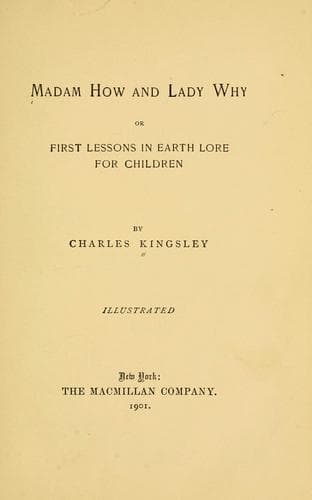
Madam How and Lady Why; Or, First Lessons in Earth Lore for ChildrenKingsley, Charles
History
Madam How and Lady Why; Or, First Lessons in Earth Lore for Children
Kingsley, Charles
Geology -- Juvenile literature; Natural history -- Juvenile literature
Better to say that you are a spirit. But what does St. Paul say? That
our spirit is to conquer our flesh, and keep it down. That the man in
us, in short, which is made in the likeness of God, is to conquer the
animal in us, which is made in the likeness of the dog and the cat, and
sometimes (I fear) in the likeness of the ape or the pig. You would not
wish to be like a cat, much less like an ape or a pig?
Of course not.
Then do not copy them, by competing and struggling for existence against
other people.
What do you mean?
Did you never watch the pigs feeding?
Yes, and how they grudge and quarrel, and shove each other's noses out of
the trough, and even bite each other because they are so jealous which
shall get most.
That is it. And how the biggest pig drives the others away, and would
starve them while he got fat, if the man did not drive him off in his
turn.
Oh, yes; I know.
Then no wiser than those pigs are worldly men who compete, and grudge,
and struggle with each other, which shall get most money, most fame, most
power over their fellow-men. They will tell you, my child, that that is
the true philosophy, and the true wisdom; that competition is the natural
law of society, and the source of wealth and prosperity. Do not you
listen to them. That is the wisdom of this world, which the flesh
teaches the animals; and those who follow it, like the animals, will
perish. Such men are not even as wise as Sweep the retriever.
Not as wise as Sweep?
Not they. Sweep will not take away Victor's bone, though he is ten times
as big as Victor, and could kill him in a moment; and when he catches a
rabbit, does he eat it himself?
Of course not; he brings it and lays it down at our feet.
Because he likes better to do his duty, and be praised for it, than to
eat the rabbit, dearly as he longs to eat it.
But he is only an animal. Who taught him to be generous, and dutiful,
and faithful?
Who, indeed! Not we, you know that, for he has grown up with us since a
puppy. How he learnt it, and his parents before him, is a mystery, of
which we can only say, God has taught them, we know not how. But see
what has happened--that just because dogs have learnt not to be selfish
and to compete--that is, have become civilised and tame--therefore we let
them live with us, and love them. Because they try to be good in their
simple way, therefore they too have all things added to them, and live
far happier, and more comfortable lives than the selfish wolf and fox.
But why have not all animals found out that?
I cannot tell: there may be wise animals and foolish animals, as there
are wise and foolish men. Indeed there are. I see a very wise animal
there, who never competes; for she has learned something of the golden
lesson--that it is more blessed to give than to receive; and she acts on
what she has learnt, all day long.
Which do you mean? Why, that is a bee.
Public-domain text, read in full here on John Shaqi.
Reviews
Reviews
No reviews yet
Be the first to share your thoughts on this work.
Elsewhere in the archive
Join the Discussion
Join the discussion
Sign in to leave a comment or review.
Sign InorCreate an account