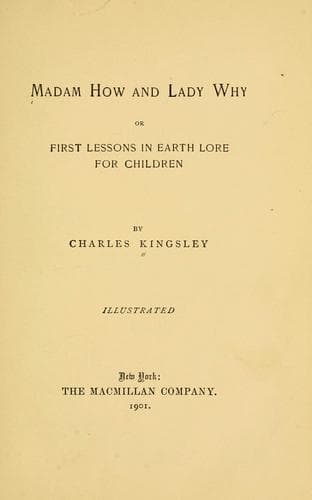
Madam How and Lady Why; Or, First Lessons in Earth Lore for ChildrenKingsley, Charles
History
Madam How and Lady Why; Or, First Lessons in Earth Lore for Children
Kingsley, Charles
Geology -- Juvenile literature; Natural history -- Juvenile literature
Ah, thereby hangs a strange tale. We will go and look at it after
breakfast, and then you shall see with your own eyes one of the wonders
which I have been telling you of.
And what is that shining between the trees?
Water.
Is it a lake?
Not a lake, though there are plenty round here; that is salt water, not
fresh. Look away to the right, and you see it through the opening of the
woods again and again: and now look above the woods. You see a faint
blue line, and gray and purple lumps like clouds, which rest upon it far
away. That, child, is the great Atlantic Ocean, and those are islands in
the far west. The water which washes the bottom of the lawn was but a
few months ago pouring out of the Gulf of Mexico, between the Bahamas and
Florida, and swept away here as the great ocean river of warm water which
we call the Gulf Stream, bringing with it out of the open ocean the
shoals of mackerel, and the porpoises and whales which feed upon them.
Some fine afternoon we will run down the bay and catch strange fishes,
such as you never saw before, and very likely see a living whale.
What? such a whale as they get whalebone from, and which eats sea-moths?
No, they live far north, in the Arctic circle; these are grampuses, and
bottle-noses, which feed on fish; not so big as the right whales, but
quite big enough to astonish you, if one comes up and blows close to the
boat. Get yourself dressed and come down, and then we will go out; we
shall have plenty to see and talk of at every step.
Now, you have finished your breakfast at last, so come along, and we
shall see what we shall see. First run out across the gravel, and
scramble up that bank of lawn, and you will see what you fancied was an
empty flower-bed.
Why, it is all hard rock.
Ah, you are come into the land of rocks now: out of the land of sand and
gravel; out of a soft young corner of the world into a very hard, old,
weather-beaten corner; and you will see rocks enough, and too many for
the poor farmers, before you go home again.
But how beautifully smooth and flat the rock is: and yet it is all
rounded.
What is it like?
Like--like the half of a shell.
Not badly said, but think again.
Like--like--I know what it is like. Like the back of some great monster
peeping up through the turf.
You have got it. Such rocks as these are called in Switzerland "roches
moutonnees," because they are, people fancy, like sheep's backs. Now
look at the cracks and layers in it. They run across the stone; they
have nothing to do with the shape of it. You see that?
Yes: but here are cracks running across them, all along the stone, till
the turf hides them.
Look at them again; they are no cracks; they do not go into the stone.
I see. They are scratched; something like those on the elder-stem at
home, where the cats sharpen their claws. But it would take a big cat to
make them.
Public-domain text, read in full here on John Shaqi.
Reviews
Reviews
No reviews yet
Be the first to share your thoughts on this work.
Elsewhere in the archive
Join the Discussion
Join the discussion
Sign in to leave a comment or review.
Sign InorCreate an account