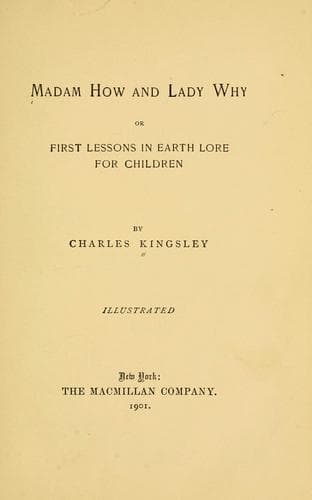
Madam How and Lady Why; Or, First Lessons in Earth Lore for ChildrenKingsley, Charles
History
Madam How and Lady Why; Or, First Lessons in Earth Lore for Children
Kingsley, Charles
Geology -- Juvenile literature; Natural history -- Juvenile literature
No, no. How did it get to London from hence? For from this country it
came. I suppose the English brought it home in Queen Bess's or James the
First's time.
But if it is wild here, and will grow so well in England, why do we not
find it wild in England too?
For the same reason that there are no toads or snakes in Ireland. They
had not got as far as Ireland before Ireland was parted off from England.
And St. Patrick's cabbage, and a good many other plants, had not got as
far as England.
But why?
Why, I don't know. But this I know: that when Madam How makes a new sort
of plant or animal, she starts it in one single place, and leaves it to
take care of itself and earn its own living--as she does you and me and
every one--and spread from that place all round as far as it can go. So
St. Patrick's cabbage got into this south-west of Ireland, long, long
ago; and was such a brave sturdy little plant, that it clambered up to
the top of the highest mountains, and over all the rocks. But when it
got to the rich lowlands to the eastward, in county Cork, it found all
the ground taken up already with other plants; and as they had enough to
do to live themselves, they would not let St. Patrick's cabbage settle
among them; and it had to be content with living here in the
far-west--and, what was very sad, had no means of sending word to its
brothers and sisters in the Pyrenees how it was getting on.
What do you mean? Are you making fun of me?
Not the least. I am only telling you a very strange story, which is
literally true. Come, and sit down on this bench. You can't catch that
great butterfly, he is too strong on the wing for you.
But oh, what a beautiful one!
Yes, orange and black, silver and green, a glorious creature. But you
may see him at home sometimes: that plant close to you, you cannot see at
home.
Why, it is only great spurge, such as grows in the woods at home.
No. It is Irish spurge which grows here, and sometimes in Devonshire,
and then again in the west of Europe, down to the Pyrenees. Don't touch
it. Our wood spurge is poisonous enough, but this is worse still; if you
get a drop of its milk on your lip or eye, you will be in agonies for
half a day. That is the evil plant with which the poachers kill the
salmon.
How do they do that?
When the salmon are spawning up in the little brooks, and the water is
low, they take that spurge, and grind it between two stones under water,
and let the milk run down into the pool; and at that all the poor salmon
turn up dead. Then comes the water-bailiff, and catches the poachers.
Then comes the policeman, with his sword at his side and his truncheon
under his arm: and then comes a "cheap journey" to Tralee Gaol, in which
those foolish poachers sit and reconsider themselves, and determine not
to break the salmon laws--at least till next time.
Public-domain text, read in full here on John Shaqi.
Reviews
Reviews
No reviews yet
Be the first to share your thoughts on this work.
Elsewhere in the archive
Join the Discussion
Join the discussion
Sign in to leave a comment or review.
Sign InorCreate an account