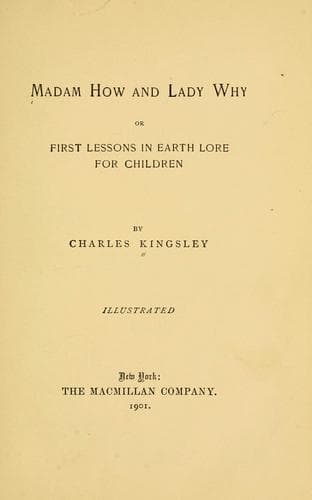
Madam How and Lady Why; Or, First Lessons in Earth Lore for ChildrenKingsley, Charles
History
Madam How and Lady Why; Or, First Lessons in Earth Lore for Children
Kingsley, Charles
Geology -- Juvenile literature; Natural history -- Juvenile literature
That these foolish people are handed over--as you and I shall be if we do
wrong wilfully--to Madam How and her terrible school-house, which is
called Nature and the Law, to be treated just as the plants and animals
are treated, because they did not choose to behave like men and children
of God. And there they learn, whether they like or not, what they might
have learnt from Lady Why all along. They learn the great law, that as
men sow so they will reap; as they make their bed so they will lie on it:
and Madam How can teach that as no one else can in earth or heaven: only,
unfortunately for her scholars, she is apt to hit so hard with her rod,
which is called Experience, that they never get over it; and therefore
most of those who will only be taught by Nature and Law are killed, poor
creatures, before they have learnt their lesson; as many a savage tribe
is destroyed, ay and great and mighty nations too--the old Roman Empire
among them.
And the poor Jews, who were carried away captive to Babylon?
Yes; they would not listen to Lady Why, and so they were taken in hand by
Madam How, and were seventy years in her terrible school-house, learning
a lesson which, to do them justice, they never forgot again. But now we
will talk of something pleasanter. We will go back to Lady Why, and
listen to her voice. It sounds gentle and cheerful enough just now.
Listen.
What? is she speaking to us now?
Hush! open your eyes and ears once more, for you are growing sleepy with
my long sermon. Watch the sleepy shining water, and the sleepy green
mountains. Listen to the sleepy lapping of the ripple, and the sleepy
sighing of the woods, and let Lady Why talk to you through them in "songs
without words," because they are deeper than all words, till you, too,
fall asleep with your head upon my knee.
But what does she say?
She says--"Be still. The fulness of joy is peace." There, you are fast
asleep; and perhaps that is the best thing for you; for sleep will (so I
am informed, though I never saw it happen, nor any one else) put fresh
gray matter into your brain; or save the wear and tear of the old gray
matter; or something else--when they have settled what it is to do: and
if so, you will wake up with a fresh fiddle-string to your little fiddle
of a brain, on which you are playing new tunes all day long. So much the
better: but when I believe that your brain is you, pretty boy, then I
shall believe also that the fiddler is his fiddle.
CHAPTER XII--HOMEWARD BOUND
Come: I suppose you consider yourself quite a good sailor by now?
Oh, yes. I have never been ill yet, though it has been quite rough again
and again.
What you call rough, little man. But as you are grown such a very good
sailor, and also as the sea is all but smooth, I think we will have a
sail in the yacht to-day, and that a tolerably long one.
Oh, how delightful! but I thought we were going home; and the things are
all packed up.
Public-domain text, read in full here on John Shaqi.
Reviews
Reviews
No reviews yet
Be the first to share your thoughts on this work.
Elsewhere in the archive
Join the Discussion
Join the discussion
Sign in to leave a comment or review.
Sign InorCreate an account