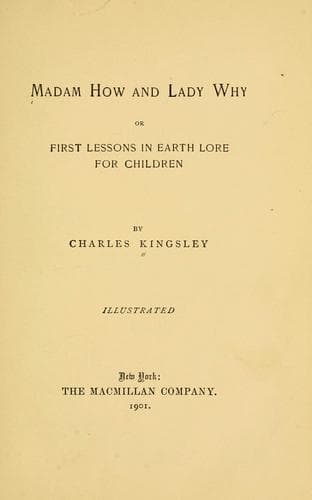
Madam How and Lady Why; Or, First Lessons in Earth Lore for ChildrenKingsley, Charles
History
Madam How and Lady Why; Or, First Lessons in Earth Lore for Children
Kingsley, Charles
Geology -- Juvenile literature; Natural history -- Juvenile literature
Just because it is set on flat, not upright: and learned men will tell
you that those two flukes are the "rudiments"--that is, either the
beginning, or more likely the last remains--of two hind feet. But that
belongs to the second volume of Madam How's Book of Kind; and you have
not yet learned any of the first volume, you know, except about a few
butterflies. Look here! Here are more whales coming. Don't be
frightened. They are only little ones, mackerel-hunting, like the big
one.
What pretty smooth things, turning head over heels, and saying, "Hush,
Hush!"
They don't really turn clean over; and that "Hush" is their way of
breathing.
Are they the young ones of that great monster?
No; they are porpoises. That big one is, I believe, a bottle-nose. But
if you want to know about the kinds of whales, you must ask Dr. Flower at
the Royal College of Surgeons, and not me: and he will tell you wonderful
things about them.--How some of them have mouths full of strong teeth,
like these porpoises; and others, like the great sperm whale in the South
Sea, have huge teeth in their lower jaws, and in the upper only holes
into which those teeth fit; others like the bottle-nose, only two teeth
or so in the lower jaw; and others, like the narwhal, two straight tusks
in the upper jaw, only one of which grows, and is what you call a
narwhal's horn.
Oh yes. I know of a walking-stick made of one.
And strangest of all, how the right-whales have a few little teeth when
they are born, which never come through the gums; but, instead, they grow
all along their gums, an enormous curtain of clotted hair, which serves
as a net to keep in the tiny sea-animals on which they feed, and let the
water strain out.
You mean whalebone? Is whalebone hair?
So it seems. And so is a rhinoceros's horn. A rhinoceros used to be
hairy all over in old times: but now he carries all his hair on the end
of his nose, except a few bristles on his tail. And the right-whale, not
to be done in oddity, carries all his on his gums.
But have no whales any hair?
No real whales: but the Manati, which is very nearly a whale, has long
bristly hair left. Don't you remember M.'s letter about the one he saw
at Rio Janeiro?
This is all very funny: but what is the use of knowing so much about
things' teeth and hair?
Public-domain text, read in full here on John Shaqi.
Reviews
Reviews
No reviews yet
Be the first to share your thoughts on this work.
Elsewhere in the archive
Join the Discussion
Join the discussion
Sign in to leave a comment or review.
Sign InorCreate an account