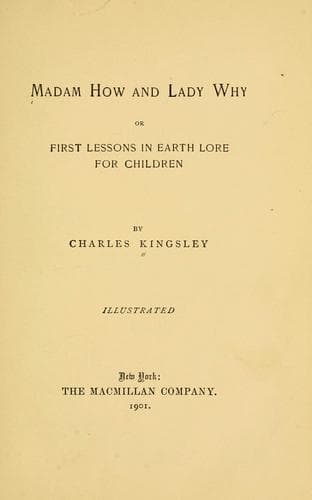
Madam How and Lady Why; Or, First Lessons in Earth Lore for ChildrenKingsley, Charles
History
Madam How and Lady Why; Or, First Lessons in Earth Lore for Children
Kingsley, Charles
Geology -- Juvenile literature; Natural history -- Juvenile literature
It is high tide now. That is why the water is almost up to the branches
of the trees. But when the tide turns, it will all rush out in a torrent
which would sweep ships out to sea again, if they had not steam, as we
have, to help them up against the stream. So sailing ships, in old
times, fastened themselves to those rings, and rode against the stream
till the tide turned, and carried them up to Bristol.
But what is the tide? And why does it go up and down? And why does it
alter with the moon, as I heard you all saying so often in Ireland?
That is a long story, which I must tell you something about some other
time. Now I want you to look at something else: and that is, the rocks
themselves, in which the rings are. They are very curious in my eyes,
and very valuable; for they taught me a lesson in geology when I was
quite a boy: and I want them to teach it to you now.
What is there curious in them?
This. You will soon see for yourself, even from the steamer's deck, that
they are not the same rock as the high limestone hills above. They are
made up of red sand and pebbles; and they are a whole world younger,
indeed some say two worlds younger, than the limestone hills above, and
lie upon the top of the limestone. Now you may see what I meant when I
said that the newer rocks, though they lie on the top of the older, were
often lower down than they are.
But how do you know that they lie on the limestone?
Look into that corner of the river, as we turn round, and you will see
with your own eyes. There are the sandstones, lying flat on the turned-
up edges of another rock.
Yes; I see. The layers of it are almost upright.
Then that upright rock underneath is part of the great limestone hill
above. So the hill must have been raised out of the sea, ages ago, and
eaten back by the waves; and then the sand and pebbles made a beach at
its foot, and hardened into stone; and there it is. And when you get
through the limestone hills to Bristol, you will see more of these same
red sandstone rocks, spread about at the foot of the limestone-hills, on
the other side.
But why is the sandstone two worlds newer than the limestone?
Because between that sandstone and that limestone come hundreds of feet
of rock, which carry in them all the coal in England. Don't you remember
that I told you that once before?
Oh yes. But I see no coal between them there.
No. But there is plenty of coal between them over in Wales; and plenty
too between them on the other side of Bristol. What you are looking at
there is just the lip of a great coal-box, where the bottom and the lid
join. The bottom is the mountain limestone; and the lid is the new red
sandstone, or Trias, as they call it now: but the coal you cannot see. It
is stowed inside the box, miles away from here. But now, look at the
cliffs and the downs, which (they tell me) are just like the downs in the
Holy Land; and the woods and villas, high over your head.
Public-domain text, read in full here on John Shaqi.
Reviews
Reviews
No reviews yet
Be the first to share your thoughts on this work.
Elsewhere in the archive
Join the Discussion
Join the discussion
Sign in to leave a comment or review.
Sign InorCreate an account