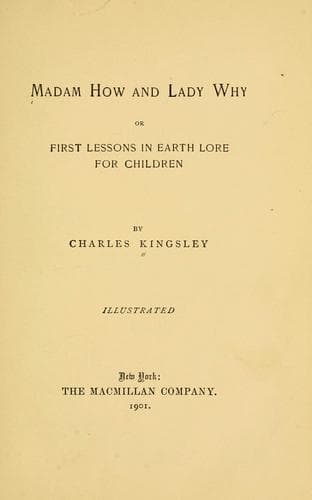
Madam How and Lady Why; Or, First Lessons in Earth Lore for ChildrenKingsley, Charles
History
Madam How and Lady Why; Or, First Lessons in Earth Lore for Children
Kingsley, Charles
Geology -- Juvenile literature; Natural history -- Juvenile literature
Yes. There are such things in the soil; and little enough of them, as
the farmers here know too well. For we here, in Windsor Forest, are on
the very poorest and almost the newest soil in England; and when Madam
How had used up all her good materials in making the rest of the island,
she carted away her dry rubbish and shot it down here for us to make the
best of; and I do not think that we and our forefathers have done so very
ill with it. But where the rich part, or staple, of our soils came from
first it would be very difficult to say, so often has Madam How made, and
unmade, and re-made England, and sifted her materials afresh every time.
But if you go to the Lowlands of Scotland, you may soon see where the
staple of the soil came from there, and that I was right in saying that
there were atoms of lava in every Scotch boy's broth. Not that there
were ever (as far as I know) volcanos in Scotland or in England. Madam
How has more than one string to her bow, or two strings either; so when
she pours out her lavas, she does not always pour them out in the open
air. Sometimes she pours them out at the bottom of the sea, as she did
in the north of Ireland and the south-west of Scotland, when she made the
Giant's Causeway, and Fingal's Cave in Staffa too, at the bottom of the
old chalk ocean, ages and ages since. Sometimes she squirts them out
between the layers of rock, or into cracks which the earthquakes have
made, in what are called trap dykes, of which there are plenty to be seen
in Scotland, and in Wales likewise. And then she lifts the earth up from
the bottom of the sea, and sets the rain to wash away all the soft rocks,
till the hard lava stands out in great hills upon the surface of the
ground. Then the rain begins eating away those lava-hills likewise, and
manuring the earth with them; and wherever those lava-hills stand up,
whether great or small, there is pretty sure to be rich land around them.
If you look at the Geological Map of England and Ireland, and the red
spots upon it, which will show you where those old lavas are, you will
see how much of them there is in England, at the Lizard Point in
Cornwall, and how much more in Scotland and the north of Ireland. In
South Devon, in Shropshire--with its beautiful Wrekin, and Caradoc, and
Lawley--in Wales, round Snowdon (where some of the soil is very rich),
and, above all, in the Lowlands of Scotland, you see these red marks,
showing the old lavas, which are always fertile, except the poor old
granite, which is of little use save to cut into building stone, because
it is too full of quartz--that is, flint.
Public-domain text, read in full here on John Shaqi.
Reviews
Reviews
No reviews yet
Be the first to share your thoughts on this work.
Elsewhere in the archive
Join the Discussion
Join the discussion
Sign in to leave a comment or review.
Sign InorCreate an account