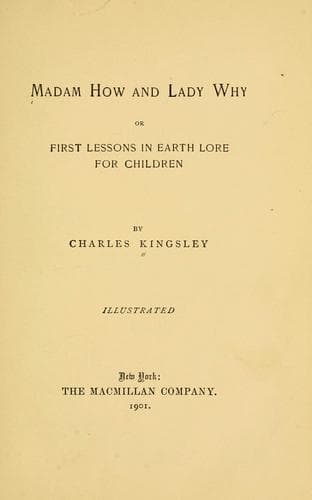
Madam How and Lady Why; Or, First Lessons in Earth Lore for ChildrenKingsley, Charles
History
Madam How and Lady Why; Or, First Lessons in Earth Lore for Children
Kingsley, Charles
Geology -- Juvenile literature; Natural history -- Juvenile literature
And therefore he will never do anything but fail, when he tries to find
out the life in things. How can he, when he has to take the life out of
them first? He could not even find out how a plum-pudding is made by
merely analysing it. He might part the sugar, and the flour, and the
suet; he might even (for he is very clever, and very patient too, the
more honour to him) take every atom of sugar out of the flour with which
it had got mixed, and every atom of brown colour which had got out of the
plums and currants into the body of the pudding, and then, for aught I
know, put the colouring matter back again into the plums and currants;
and then, for aught I know, turn the boiled pudding into a raw one
again,--for he is a great conjurer, as Madam How's grandson is bound to
be: but yet he would never find out how the pudding was made, unless some
one told him the great secret which the sailors in the old story
forgot--that the cook boiled it in a cloth.
This is Analysis's weak point--don't let it be yours--that in all his
calculations he is apt to forget the cloth, and indeed the cook likewise.
No doubt he can analyse the matter of things: but he will keep forgetting
that he cannot analyse their form.
Do I mean their shape?
No, my child; no. I mean something which makes the shape of things, and
the matter of them likewise, but which folks have lost sight of nowadays,
and do not seem likely to get sight of again for a few hundred years. So
I suppose that you need not trouble your head about it, but may just
follow the fashions as long as they last.
About this piece of lime, however, Analysis can tell us a great deal. And
we may trust what he says, and believe that he understands what he says.
Why?
Think now. If you took your watch to pieces, you would probably spoil it
for ever; you would have perhaps broken, and certainly mislaid, some of
the bits; and not even a watchmaker could put it together again. You
would have analysed the watch wrongly. But if a watchmaker took it to
pieces then any other watchmaker could put it together again to go as
well as ever, because they both understand the works, how they fit into
each other, and what the use and the power of each is. Its being put
together again rightly would be a proof that it had been taken to pieces
rightly.
And so with Master Analysis. If he can take a thing to pieces so that
his brother Synthesis can put it together again, you may be sure that he
has done his work rightly.
Now he can take a bit of chalk to pieces, so that it shall become several
different things, none of which is chalk, or like chalk at all. And then
his brother Synthesis can put them together again, so that they shall
become chalk, as they were before. He can do that very nearly, but not
quite. There is, in every average piece of chalk, something which he
cannot make into chalk again when he has once unmade it.
Public-domain text, read in full here on John Shaqi.
Reviews
Reviews
No reviews yet
Be the first to share your thoughts on this work.
Elsewhere in the archive
Join the Discussion
Join the discussion
Sign in to leave a comment or review.
Sign InorCreate an account