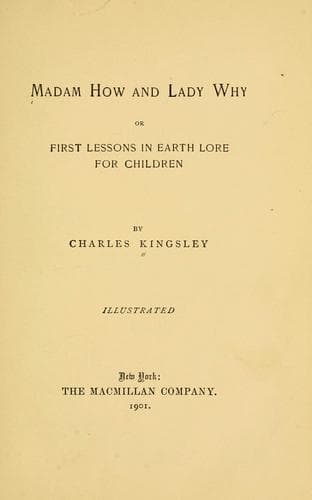
Madam How and Lady Why; Or, First Lessons in Earth Lore for ChildrenKingsley, Charles
History
Madam How and Lady Why; Or, First Lessons in Earth Lore for Children
Kingsley, Charles
Geology -- Juvenile literature; Natural history -- Juvenile literature
Well, perhaps it is: but you must remember that, though he is very old--as
old as the first man who ever lived--he has only been at school for the
last three hundred years or so. And remember, too, that he is not like
you, who have some one else to teach you. He has had to teach himself,
and find out for himself, and make his own tools, and work in the dark
besides. And I think it is very much to his credit that he ever found
out that diamond and charcoal were the same things. You would never have
found it out for yourself, you will agree.
No: but how did he do it?
He taught a very famous chemist, Lavoisier, about ninety years ago, how
to burn a diamond in oxygen--and a very difficult trick that is; and
Lavoisier found that the diamond when burnt turned almost entirely into
carbonic acid and water, as blacklead and charcoal do; and more, that
each of them turned into the same quantity of carbonic acid, And so he
knew, as surely as man can know anything, that all these things, however
different to our eyes and fingers, are really made of the same
thing,--pure carbon.
But what makes them look and feel so different?
That Analysis does not know yet. Perhaps he will find out some day; for
he is very patient, and very diligent, as you ought to be. Meanwhile, be
content with him: remember that though he cannot see through a milestone
yet, he can see farther into one than his neighbours. Indeed his
neighbours cannot see into a milestone at all, but only see the outside
of it, and know things only by rote, like parrots, without understanding
what they mean and how they are made.
So now remember that chalk is carbonate of lime, and that it is made up
of three things, calcium, oxygen, and carbon; and that therefore its mark
is CaCO(3), in Analysis's language, which I hope you will be able to read
some day.
But how is it that Analysis and Synthesis cannot take all this chalk to
pieces, and put it together again?
Look here; what is that in the chalk?
Oh! a shepherd's crown, such as we often find in the gravel, only fresh
and white.
Well; you know what that was once. I have often told you:--a live sea-
egg, covered with prickles, which crawls at the bottom of the sea.
Well, I am sure that Master Synthesis could not put that together again:
and equally sure that Master Analysis might spend ages in taking it to
pieces, before he found out how it was made. And--we are lucky to-day,
for this lower chalk to the south has very few fossils in it--here is
something else which is not mere carbonate of lime. Look at it.
A little cockle, something like a wrinkled hazel-nut.
Public-domain text, read in full here on John Shaqi.
Reviews
Reviews
No reviews yet
Be the first to share your thoughts on this work.
Elsewhere in the archive
Join the Discussion
Join the discussion
Sign in to leave a comment or review.
Sign InorCreate an account