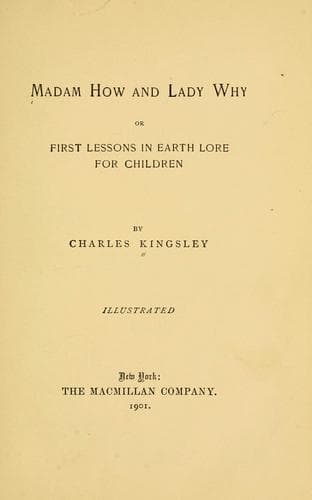
Madam How and Lady Why; Or, First Lessons in Earth Lore for ChildrenKingsley, Charles
History
Madam How and Lady Why; Or, First Lessons in Earth Lore for Children
Kingsley, Charles
Geology -- Juvenile literature; Natural history -- Juvenile literature
One difference will be found between the chalk now forming at the bottom
of the ocean, if it ever become dry land, and the chalk on which you
tread on the downs. The new chalk will be full of the teeth and bones of
whales--warm-blooded creatures, who suckle their young like cows, instead
of laying eggs, like birds and fish. For there were no whales in the old
chalk ocean; but our modern oceans are full of cachalots, porpoises,
dolphins, swimming in shoals round any ship; and their bones and teeth,
and still more their ear-bones, will drop to the bottom as they die, and
be found, ages hence, in the mud which the live atomies make, along with
wrecks of mighty ships
"Great anchors, heaps of pearl,"
and all that man has lost in the deep seas. And sadder fossils yet, my
child, will be scattered on those white plains:--
"To them the love of woman hath gone down,
Dark roll their waves o'er manhood's noble head.
O'er youth's bright locks, and beauty's flowing crown;
Yet shall they hear a voice, 'Restore the dead.'
Earth shall reclaim her precious things from thee.
Give back the dead, thou Sea!"
CHAPTER IX--THE CORAL-REEF
Now you want to know what I meant when I talked of a bit of lime going
out to sea, and forming part of a coral island, and then of a limestone
rock, and then of a marble statue. Very good. Then look at this stone.
What a curious stone! Did it come from any place near here?
No. It came from near Dudley, in Staffordshire, where the soils are
worlds on worlds older than they are here, though they were made in the
same way as these and all other soils. But you are not listening to me.
Why, the stone is full of shells, and bits of coral; and what are these
wonderful things coiled and tangled together, like the snakes in Medusa's
hair in the picture? Are they snakes?
If they are, then they must be snakes who have all one head; for see,
they are joined together at their larger ends; and snakes which are
branched, too, which no snake ever was.
Yes. I suppose they are not snakes. And they grow out of a flower, too;
and it has a stalk, jointed, too, as plants sometimes are; and as fishes'
backbones are too. Is it a petrified plant or flower?
No; though I do not deny that it looks like one. The creature most akin
to it which you ever saw is a star-fish.
What! one of the red star-fishes which one finds on the beach? Its arms
are not branched.
No. But there are star-fishes with branched arms still in the sea. You
know that pretty book (and learned book, too), Forbes's _British Star-
fishes_? You like to look it through for the sake of the vignettes,--the
mermaid and her child playing in the sea.
Oh yes, and the kind bogie who is piping while the sandstars dance; and
the other who is trying to pull out the star-fish which the oyster has
caught.
Public-domain text, read in full here on John Shaqi.
Reviews
Reviews
No reviews yet
Be the first to share your thoughts on this work.
Elsewhere in the archive
Join the Discussion
Join the discussion
Sign in to leave a comment or review.
Sign InorCreate an account