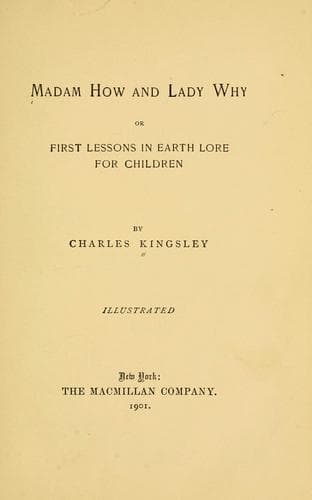
Madam How and Lady Why; Or, First Lessons in Earth Lore for ChildrenKingsley, Charles
History
Madam How and Lady Why; Or, First Lessons in Earth Lore for Children
Kingsley, Charles
Geology -- Juvenile literature; Natural history -- Juvenile literature
No. She only believed what the Whitby folk, I understand, have some of
them believed for many hundred years. And no one can be blamed for
thinking as his forefathers did, unless he has cause to know better.
Surely she might have known better?
How? What reason could she have to believe the Ammonite was a shell? It
is not the least like cockles, or whelks, or any shell she ever saw.
What reason either could she have to guess that Whitby cliff had once
been coral-mud, at the bottom of the sea? No more reason, my dear child,
than you would have to guess that this stone had been coral-mud likewise,
if I did not teach you so,--or rather, try to make you teach yourself so.
No. I say it again. If you wish to learn, I will only teach you on
condition that you do not laugh at, or despise, those good and honest and
able people who do not know or care about these things, because they have
other things to think of: like old John out there ploughing. He would
not believe you--he would hardly believe me--if we told him that this
stone had been once a swarm of living things, of exquisite shapes and
glorious colours. And yet he can plough and sow, and reap and mow, and
fell and strip, and hedge and ditch, and give his neighbours sound
advice, and take the measure of a man's worth from ten minutes' talk, and
say his prayers, and keep his temper, and pay his debts,--which last
three things are more than a good many folks can do who fancy themselves
a whole world wiser than John in the smock-frock.
Oh, but I want to hear about the exquisite shapes and glorious colours.
Of course you do, little man. A few fine epithets take your fancy far
more than a little common sense and common humility; but in that you are
no worse than some of your elders. So now for the exquisite shapes and
glorious colours. I have never seen them; though I trust to see them ere
I die. So what they are like I can only tell from what I have learnt
from Mr. Darwin, and Mr. Wallace, and Mr. Jukes, and Mr. Gosse, and last,
but not least, from one whose soul was as beautiful as his face, Lucas
Barrett,--too soon lost to science,--who was drowned in exploring such a
coral-reef as this stone was once.
Then there are such things alive now?
Yes, and no. The descendants of most of them live on, altered by time,
which alters all things; and from the beauty of the children we can guess
at the beauty of their ancestors; just as from the coral-reefs which
exist now we can guess how the coral-reefs of old were made. And that
this stone was once part of a coral-reef the corals in it prove at first
sight.
And what is a coral-reef like?
You have seen the room in the British Museum full of corals, madrepores,
brain-stones, corallines, and sea-ferns?
Oh yes.
Public-domain text, read in full here on John Shaqi.
Reviews
Reviews
No reviews yet
Be the first to share your thoughts on this work.
Elsewhere in the archive
Join the Discussion
Join the discussion
Sign in to leave a comment or review.
Sign InorCreate an account