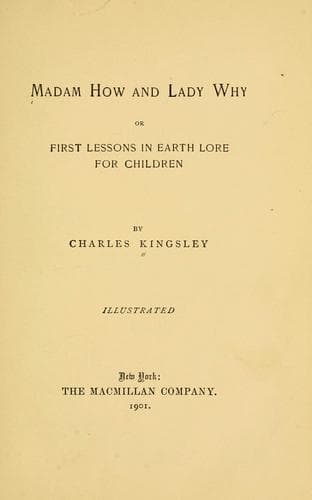
Madam How and Lady Why; Or, First Lessons in Earth Lore for ChildrenKingsley, Charles
History
Madam How and Lady Why; Or, First Lessons in Earth Lore for Children
Kingsley, Charles
Geology -- Juvenile literature; Natural history -- Juvenile literature
Of course the coral polypes cannot build above the high-tide mark; but
the surf which beats upon them piles up their broken fragments just as a
sea-beach is piled up, and hammers them together with that water hammer
which is heavier and stronger than any you have ever seen in a smith's
forge. And then, as is the fashion of lime, the whole mass sets and
becomes hard, as you may see mortar set; and so you have a low island a
few feet above the sea. Then sea-birds come to it, and rest and build;
and seeds are floated thither from far lands; and among them almost
always the cocoa-nut, which loves to grow by the sea-shore, and groves of
cocoa palms grow up upon the lonely isle. Then, perhaps, trees and
bushes are drifted thither before the trade-wind; and entangled in their
roots are seeds of other plants, and eggs or cocoons of insects; and so a
few flowers and a few butterflies and beetles set up for themselves upon
the new land. And then a bird or two, caught in a storm and blown away
to sea finds shelter in the cocoa-grove; and so a little new world is set
up, in which (you must remember always) there are no four-footed beasts,
nor snakes, nor lizards, nor frogs, nor any animals that cannot cross the
sea. And on some of those islands they may live (indeed there is reason
to believe they have lived), so long, that some of them have changed
their forms, according to the laws of Madam How, who sooner or later fits
each thing exactly for the place in which it is meant to live, till upon
some of them you may find such strange and unique creatures as the famous
cocoa-nut crab, which learned men call _Birgus latro_. A great crab he
is, who walks upon the tips of his toes a foot high above the ground. And
because he has often nothing to eat but cocoa-nuts, or at least they are
the best things he can find, cocoa-nuts he has learned to eat, and after
a fashion which it would puzzle you to imitate. Some say that he climbs
up the stems of the cocoa-nut trees, and pulls the fruit down for
himself; but that, it seems, he does not usually do. What he does is
this: when he finds a fallen cocoa-nut, he begins tearing away the thick
husk and fibre with his strong claws; and he knows perfectly well which
end to tear it from, namely, from the end where the three eye-holes are,
which you call the monkey's face, out of one of which you know, the young
cocoa-nut tree would burst forth. And when he has got to the eye-holes,
he hammers through one of them with the point of his heavy claw. So far,
so good: but how is he to get the meat out? He cannot put his claw in.
He has no proboscis like a butterfly to insert and suck with. He is as
far off from his dinner as the fox was when the stork offered him a feast
in a long-necked jar. What then do you think he does? He turns himself
round, puts in a pair of his hind pincers, which are very slender, and
with them scoops the meat out of the cocoa-nut, and so puts his dinner
into his mouth with his hind feet.
Public-domain text, read in full here on John Shaqi.
Reviews
Reviews
No reviews yet
Be the first to share your thoughts on this work.
Elsewhere in the archive
Join the Discussion
Join the discussion
Sign in to leave a comment or review.
Sign InorCreate an account