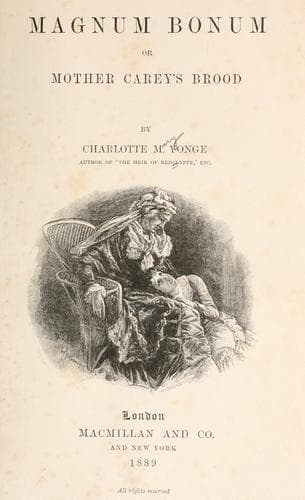
Magnum Bonum; Or, Mother Carey's BroodYonge, Charlotte M. (Charlotte Mary)
General
Magnum Bonum; Or, Mother Carey's Brood
Yonge, Charlotte M. (Charlotte Mary)
Domestic fiction; England -- Social life and customs -- 19th century -- Fiction; Religious fiction
But Janet’s elder-sisterly authority was never accepted by the newcomer.
“I couldn’t mind her, she looked so ugly,” said she in excuse; and
probably the heavy, brown, dull complexion and large features were
repulsive in themselves to the sensitive fancy of the creature of life
and beauty. At any rate, they were jarring elephants, as said Eleanor,
who was growing ambitious, and sometimes electrified the public with
curious versions of the long words more successfully used by Armine and
Babie.
Caroline succeeded in modelling a very lovely profile in bas-relief of
the exquisite little head, and then had it photographed. Mary Ogilvie,
coming to Kenminster as usual when her holidays began in June, found the
photograph in the place of honour on her brother’s chimney-piece, and a
little one beside it of the artist herself.
So far as Carey herself was concerned, Mary was much better satisfied.
She did not look so worn or so flighty, and had a quieter and more
really cheerful tone and manner, as of one who had settled into her home
and occupations. She had made friends, too--few, but worth having;
and there were those who pronounced the Folly the pleasantest house in
Kenminster, and regarded the five o’clock tea, after the weekly physical
science lecture at the school, as a delightful institution.
Of course, the schoolmaster was one of these; and when Mary found
how all his paths tended to the Pagoda, she hated herself for being a
suspicious old duenna. Nevertheless, she could not but be alarmed by
finding that her project of a walking tour through Brittany was not,
indeed, refused, but deferred, with excuses about having work to finish,
being in no hurry, and the like.
“I think you ought to go,” said Mary at last.
“I see no ought in the case. Last year the work dragged, and was
oppressive; but you see how different it has become.”
“That is the very reason,” said Mary, the colour flying to her checks.
“It will not do to stay lingering here as we did last summer, and not
only on your own account.”
“You need not be afraid,” was the muttered answer, as David bent down
his head over the exercise he was correcting. She made no answer, and
ere long he began again, “I don’t mean that her equal exists, but I am
not such a fool as to delude myself with a spark of hope.”
“She is too nice for that,” said Mary.
“Just so,” he said, glad to relieve himself when the ice had been
broken. “There’s something about her that makes one feel her to be
altogether that doctor’s, as much as if he were present in the flesh.”
“Are you hoping to wear that out? For I don’t think you will.”
“I told you I had no hope,” he answered, rather petulantly. “Even were
it otherwise, there is another thing that must withhold me. It has got
abroad that she may turn out heiress to the old man at Belforest.”
“In such a hopeless case, would it not be wiser to leave this place
altogether?”
Public-domain text, read in full here on John Shaqi.
Reviews
Reviews
No reviews yet
Be the first to share your thoughts on this work.
Elsewhere in the archive
Join the Discussion
Join the discussion
Sign in to leave a comment or review.
Sign InorCreate an account