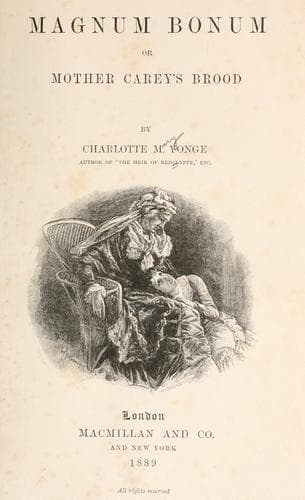
Magnum Bonum; Or, Mother Carey's BroodYonge, Charlotte M. (Charlotte Mary)
General
Magnum Bonum; Or, Mother Carey's Brood
Yonge, Charlotte M. (Charlotte Mary)
Domestic fiction; England -- Social life and customs -- 19th century -- Fiction; Religious fiction
All the work in the school seemed flat and poor, except perhaps
Johnny’s, which steadily improved. Robert, whose father wished him to be
pushed on so as to be fit for examination for Sandhurst, opposed, to all
pressure, the passive resistance of stolidity. He was nearly sixteen,
but seemed incapable of understanding that compulsory studies were for
his good and not a cruel exercise of tyranny. He disdainfully rejected
an offer from his aunt to help him in the French and arithmetic which
had become imminent, while of the first he knew much less than Babie,
and of the latter only as much as would serve to prevent his being daily
“kept in.”
One chilly autumn afternoon, Armine was seen, even by the unobservant
under-master, to be shivering violently, and his teeth chattering so
that he could not speak plainly.
“You ought to be at home,” said Mr. Perkins. “Here, you, Brownlow
maximus, just see him home, and tell his mother that he should be seen
to.”
“I can go alone,” Armine tried to say; but Mr. Perkins thought the
head-master could not say he neglected one who was felt to be a favoured
scholar if he sent his cousin with him.
So presently Armine was pushed in at the back door, with these words
from Rob to the cook--“Look here, he’s been and got cold, or something.”
Rob then disappeared, and Armine struggled in to the kitchen fire,
white, sobbing and panting, and, as the compassionate maids discovered,
drenched from head to foot, his hair soaked, his boots squishing with
water. His mother and sisters were out, and as cook administered the
hottest draught she could compound, and Emma tugged at his jacket, they
indignantly demanded what he had been doing to himself.
“Nothing,” he said. “I’ll go and take my things off; only please don’t
tell mother.”
“Yes,” said old nurse, who had tottered in, but who was past fully
comprehending emergencies; “go and get into bed, my dear, and Emma shall
come and warm it for him.”
“No,” stoutly said the little boy; “there’s nothing the matter, and
mother must not know.”
“Take my word for it,” said cook, “that child have a been treated
shameful by those great nasty brutes of big boys.”
And when Armine, too cold to sit anywhere but by the only fire in the
house, returned with a book and begged humbly for leave to warm himself,
he was installed on nurse’s footstool, in front of a huge fire, and hot
tea and “lardy-cake” tendered for his refreshment, while the maids by
turns pitied and questioned him.
“Have you had a haccident, sir,” asked cook.
“No,” he wearily said.
“Have any one been doing anything to you, then?” And as he did not
answer she continued: “You need not think to blind me, sir; I sees it as
if it was in print. Them big boys have been a-misusing of you.”
“Now, cook, you ain’t to say a word to my mother,” cried Armine,
vehemently. “Promise me.”
“If you’ll tell me all about it, sir,” said cook, coaxingly.
“No,” he answered, “I promised!” And he buried his head in nurse’s lap.
Public-domain text, read in full here on John Shaqi.
Reviews
Reviews
No reviews yet
Be the first to share your thoughts on this work.
Elsewhere in the archive
Join the Discussion
Join the discussion
Sign in to leave a comment or review.
Sign InorCreate an account