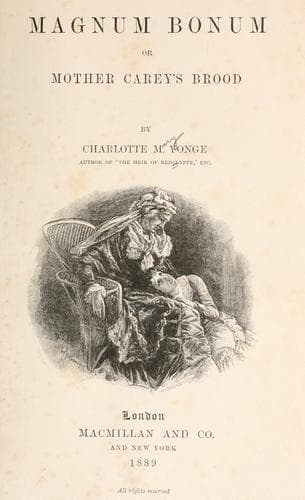
Magnum Bonum; Or, Mother Carey's BroodYonge, Charlotte M. (Charlotte Mary)
General
Magnum Bonum; Or, Mother Carey's Brood
Yonge, Charlotte M. (Charlotte Mary)
Domestic fiction; England -- Social life and customs -- 19th century -- Fiction; Religious fiction
“I should think not!” he laughed. “Nobody would trust me.”
“Is that the only reason?” she said, sadly, and he looked up in her
face, squeezed her hand, and muttered--
“One mayn’t like dirt without making such a row.”
“That’s like father’s boy,” she said, and he wrung her hand again.
They found Armine coiled up before the fire with a book, and Jock
greeted him with--
“Well, you little donkey, there’s such a shindy at the Croft as you
never heard.”
“Mother, you know!” cried Armine, running into her outstretched arms and
being covered with her kisses. “But who told?” he asked.
“John and Jessie,” said Jock. “They always said they would if anyone
said anything against you to mother or Uncle Robert.”
“Against me?” said Armine.
“Yes,” said Jock. “Didn’t you know it got about through some of the
juniors or their sisters that it was Brownlow maximus gently chastising
you for bad language, and of course Mrs. Coffinkey told Aunt Ellen.”
“Oh, but Jock,” cried Armine, turning round in consternation, “I hope
Rob does not know.”
And on further pressing it was extracted that Rob, when sent home with
him, had threatened him with the great black vaulted cellars of Kencroft
if he divulged the truth. When Jock left them the relief of pouring out
the whole history to the mother was evidently great.
“You know, mother, I couldn’t,” he cried, as if there had been a
physical impossibility.
“Why, dear child. How did you bear their horrid cruelty?”
“I thought it could not be so bad as it was for the forty soldiers on
the Lake. Dear grandmamma read us the story out of a little red book one
Sunday evening when you were gone to Church. They froze, you know, and
it was only cold and nasty for me.”
“So the thought of them carried you through?”
“God carried me through,” said the child reverently. “I asked Him not to
let me break His Commandment.”
Just then the Colonel’s heavy tread was heard, and with him came Mr.
Ogilvie, whom he had met on the road and informed. The good man was
indeed terribly grieved, and his first words were, “Caroline, I cannot
tell you how much shocked and concerned I am;” and then he laid his hand
on Armine’s shoulder saying--“My little boy, I am exceedingly sorry for
what you have suffered. One day Robert will be so too. You have been
a noble little fellow, and if anything could console me for the part
Robert has played it would be the seeing one of my dear brother’s sons
so like his father.”
He gave the downcast brow a fatherly kiss, so really like those of days
gone by that the boy’s overstrained spirits gushed forth in sobs and
tears, of which he was so much ashamed that he rushed out of the room,
leaving his mother greatly overcome, his uncle distressed and annoyed,
and his master not much less so, at the revelation of so much evil, so
hard either to reach or to understand.
“I would have brought Robert to apologise,” said the Colonel, “if he had
been as yet in a mood to do so properly.”
Public-domain text, read in full here on John Shaqi.
Reviews
Reviews
No reviews yet
Be the first to share your thoughts on this work.
Elsewhere in the archive
Join the Discussion
Join the discussion
Sign in to leave a comment or review.
Sign InorCreate an account