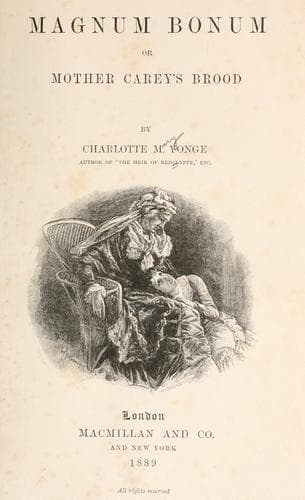
Magnum Bonum; Or, Mother Carey's BroodYonge, Charlotte M. (Charlotte Mary)
General
Magnum Bonum; Or, Mother Carey's Brood
Yonge, Charlotte M. (Charlotte Mary)
Domestic fiction; England -- Social life and customs -- 19th century -- Fiction; Religious fiction
Distressed at appearing to drive up like the lady of the house, her
Serene Highness insisted on stopping at the iron gates of the stately
approach. There she alighted, and waited to make the best setting to
rights she could of the heiress’s wind-tossed hat and cloak, and would
have put her into the carriage, but that no power could persuade her to
mount that triumphal car, and all that could be obtained was that she
should walk in the forefront of the procession with the Colonel.
There was nobody to receive them but Richards, for the servants had been
paid off, and only a keeper and his wife were living in the kitchen in
charge. There was a fire in the library, where the Colonel had business
to transact with Richards, while the ladies and children proceeded with
their explorations. It was rather awful at first in the twilight gloom
of the great hall, with a painted mythological ceiling, and cold white
pavement, varied by long perspective lines of black lozenges, on which
every footfall echoed. The first door that they opened led into a vast
and dreary dining-room, with a carpet, forming a crimson roll at one
end, and long ranks of faded leathern chairs sitting in each other’s
laps. At one end hung a huge picture by Snyders, of a bear hugging one
dog in his forepaws and tearing open the ribs of another with his hind
ones. Opposite was a wild boar impaling a hound with his tusk, and the
other walls were occupied by Herodias smiling at the contents of
her charger, Judith dropping the gory head into her bag, a brown St.
Sebastian writhing among the arrows; and Juno extracting the painfully
flesh and blood eyes of Argus to set them in her peacock’s tail.
“I object to eating my dinner in a butcher’s shop,” observed Allen.
“Yes, we must get them out of this place,” said his mother.
“They are very valuable paintings,” interposed Ellen. “I know they are
in the county history. They were collected by Sir Francis Bradford, from
whom the place was bought, and he was a great connoisseur.”
“Yes, they are just the horrid things great connoisseurs of the last
century liked, by way of giving themselves an appetite,” said Caroline.
“Are not fine pictures always horrid?” asked Jessie, in all simplicity.
Public-domain text, read in full here on John Shaqi.
Reviews
Reviews
No reviews yet
Be the first to share your thoughts on this work.
Elsewhere in the archive
Join the Discussion
Join the discussion
Sign in to leave a comment or review.
Sign InorCreate an account