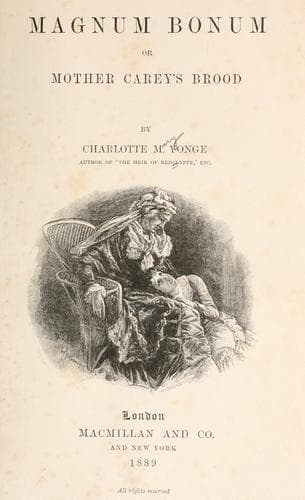
Magnum Bonum; Or, Mother Carey's BroodYonge, Charlotte M. (Charlotte Mary)
General
Magnum Bonum; Or, Mother Carey's Brood
Yonge, Charlotte M. (Charlotte Mary)
Domestic fiction; England -- Social life and customs -- 19th century -- Fiction; Religious fiction
This first summer she was free to take her own course as to society, for
Janet cared for the Cambridge examination far more than for gaiety, and
thus she had no call, and no heart for “going out,” even if she had as
yet been more known. Some morning calls were exchanged, but she sent
refusals on mourning cards to invitations to evening parties, though she
took her young people to plays, concerts, and operas, and all that was
pleasant. Her young people included Jessie. Colonel and Mrs. Brownlow
made her a visit as soon as she was settled, and were so much edified
by the absence of display and extravagance, that they did not scruple to
trust their daughter to her for the long-desired music-lessons.
Caroline had indeed made no attempt to win her way into the great world;
but she had brought together as much as possible of the old society
of her former home. On two evenings in the week, the habitues of Joe
Brownlow’s house were secure of finding her either in the drawing-room
or conservatory; beautiful things, and new books and papers on the
tables, good music on the piano, sometimes acted charades, or paper
games, according to the humour or taste of the party. If she had been
a beautiful duchess, Popinjay Parlour would have been a sort of salon
bleu; but it was really a kind of paradise to a good many clever,
hardworked men and women. Those of the upper world, such as Kenminster
county folks, old acquaintances of her husband, or natural adherents of
Midas, who found their way to these receptions, either thought them odd
but charming, or else regretted that Mrs. Brownlow should get such queer
people together, and turn Hyde Corner House into another Folly.
Mary Ogilvie enjoyed, but not without misgivings. It was delightful,
and yet, what with Joe Brownlow and his mother had been guarded, might
become less safe with no leader older or of more weight than Carey, who
could easily be carried along by what they would have checked. The older
and more intimate friends always acted as a wholesome restraint; but
when they were not present there was sometimes a tone that jarred on
the reverent ear, or dealt with life and its mysteries in a sneering,
mocking style. This was chiefly among new-comers, introduced by former
acquaintances, and it never went far; but Mary was distressed by seeing
Janet’s relish for such conversation. Nita Ray was the chief female
offender in this way, and this was the more unfortunate as Sunday was
her only free day.
Those Sundays vexed Mary’s secret soul. No one interfered with her way
of spending them; but that was the very cause of misgiving. Everybody
went to Church in the morning, but just where, and as, they pleased,
meeting at luncheon, with odd anecdotes of their adventures, and
criticisms of music or of sermons. It was an easy-going meal, lasting
long, and haunted by many acquaintances, for whose sake the table was
always at its full length, and spread with varieties of delicacies that
would endure waiting.
Public-domain text, read in full here on John Shaqi.
Reviews
Reviews
No reviews yet
Be the first to share your thoughts on this work.
Elsewhere in the archive
Join the Discussion
Join the discussion
Sign in to leave a comment or review.
Sign InorCreate an account