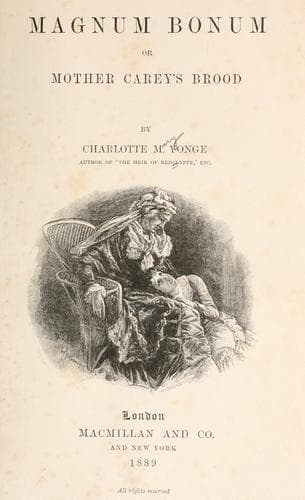
Magnum Bonum; Or, Mother Carey's BroodYonge, Charlotte M. (Charlotte Mary)
General
Magnum Bonum; Or, Mother Carey's Brood
Yonge, Charlotte M. (Charlotte Mary)
Domestic fiction; England -- Social life and customs -- 19th century -- Fiction; Religious fiction
Johnny, to whom all was more absolutely new than to the others, was the
quietest of the three. He was a year older than Lucas, as Jock was now
called to formal outsiders, while Friar John, a reversal of his cousin’s
two Christian names, was a school title that sometimes passed into
home use. Friar John then had reached an age open to the influences of
beautiful and sublime scenery, and when the younger ones only felt the
exhilaration of mountain air, and longings to get as high as possible,
his soul began to expand, and fresh revelations of glory and majesty to
take possession of him. He was a very different person from the rough,
awkward lad of eight years back. He still had the somewhat loutish
figure which, in his mother’s family, was the shell of fine-looking
men, and he was shy and bashful, but Eton polish had taken away the rude
gruffness, and made his manners and bearing gentlemanly. His face was
honest and intelligent, and he had a thoroughly good, conscientious
disposition; his character stood high, and he was the only Brownlow of
them all who knew the sweets of being “sent up for good.” His aunt could
almost watch expression deepening on his open face, and he was enjoying
with soul and mind even more than with body. Having had the illness
later and more severely than the other two, his strength had not so
fully returned, and he was often glad to rest, admire, and study the
subject with his aunt, to whose service he was specially devoted, while
the other two climbed and explored. For even Armine had been invigorated
with a sudden overflow of animal health and energy, which made him far
more enterprising and less contemplative than he had ever been before.
They four had walked up the mountain after breakfast from Kandersteg,
bringing their bags for a couple of nights, the boys being anxious to go
up the Altels the next day, as their time was nearly over and they were
to be in school in ten days’ time again. After luncheon and a good rest
on the wooden bench outside the door, they began to stroll towards the
Daubensee, along a path between desolate boulders, without vegetation,
except a small kind of monkshood.
“I call this dreary,” said the mother. “We don’t seem to get a bit
nearer the lake. I shall go home and write to Babie.”
“I’ll come back with you,” said Johnny. “My mother will be looking for a
letter.”
“Not giving in already, Johnny,” said Armine. “I can tell you I mean to
get to the lake.”
“The Friar is the slave of his note-book,” said Jock. “When are we to
have it--‘Crags and Cousins,’ or ‘From Measles to Mountains’?”
“I don’t want to forget everything,” said Johnny, with true Kencroft
doggedness.
“Do you expect ever to look at that precious diurnal again?”
“He will leave it as an heirloom to his grandchildren!”
“And they will say how slow people were in the nineteenth century.”
“There will have been a reaction by that time, and they will only wonder
how anybody cared to go up into such dreary places.”
Public-domain text, read in full here on John Shaqi.
Reviews
Reviews
No reviews yet
Be the first to share your thoughts on this work.
Elsewhere in the archive
Join the Discussion
Join the discussion
Sign in to leave a comment or review.
Sign InorCreate an account