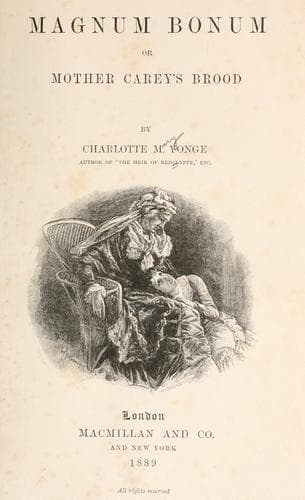
Magnum Bonum; Or, Mother Carey's BroodYonge, Charlotte M. (Charlotte Mary)
General
Magnum Bonum; Or, Mother Carey's Brood
Yonge, Charlotte M. (Charlotte Mary)
Domestic fiction; England -- Social life and customs -- 19th century -- Fiction; Religious fiction
“Nay, Elfie, you little wretch; that was quite a good rose--not fair
game,” and leaping up to give her chase in and out among the beds, they
nearly ran against Janet returning with the letters, and saying “she was
sorry to have been so long, but mother’s hoards were never easy places
of research.”
Barbara came more slowly back, and looked somewhat as if she had had a
sharper rebuke than she understood or relished.
Poor child! she had suffered much in this her first real trouble, and
a little thing was enough to overset her. She had not readily recovered
from the petulant tone of anger with which Janet told her not to come
peeping and worrying.
Janet had given a most violent start when she opened the door of her
mother’s bedroom where the davenport stood; and Janet much resented
being startled; no doubt that was the reason she was so cross, thought
Barbara, but still it was very disagreeable.
That room was the child’s also. She had been her mother’s bed-fellow
ever since her father’s death, and she felt her present solitude. The
nights were sultry, and her sleep had been broken of late.
That night she was in a slumber as cool as a widely-opened window would
make it, but not so sound that she was not haunted all the time by dread
for Armine.
Suddenly she was awakened to full consciousness by seeing a light in the
room. No, it was not the maid putting away her dresses. It was Janet,
bending over her mother’s davenport.
Babie started up.
“Janet! Is anything the matter?”
“Nothing! Nonsense! go to sleep, child.”
“What are you about?”
“Never mind. Only mother keeps her things in such a mess; I was setting
them to rights after disturbing them to find the book.”
There was something in the tone like an apology.
Babie did not like it, but she well knew that she should be
contemptuously put down if she attempted an inquiry, far less a
remonstrance, with Janet. Only, with a puzzled sort of watch-dog sense,
she sat up in bed and stared.
“Why don’t you lie down?” said Janet.
Babie did lie down, but on her back, her head high up on the pillow, and
her eyes well open still.
Perhaps Janet did not like it, for she gave an impatient shuffle to the
papers, shut the drawer with a jerk, locked it, took up her candle, and
went away without vouchsafing a “good-night.”
Babie lay wondering. She knew that the davenport contained all that was
most sacred and precious to her mother, as relics of her old life, and
that only dire necessity would have made her let anyone touch it. What
could Janet mean? To speak would be of no use. One-and-twenty was not
likely to listen to thirteen, though Babie, in her dreamy wakefulness,
found herself composing conversations in which she made eloquent appeals
to Janet, which she was never likely to utter.
Public-domain text, read in full here on John Shaqi.
Reviews
Reviews
No reviews yet
Be the first to share your thoughts on this work.
Elsewhere in the archive
Join the Discussion
Join the discussion
Sign in to leave a comment or review.
Sign InorCreate an account